
Development of the gametophytic phase of eight species of Pellaea (Pteridaceae, Polypodiophyta) present in Mexico
DOI:
https://doi.org/10.21829/abm131.2024.2401Keywords:
apogamy, bisexual, ferns, gametophyte, spore, unisexualAbstract
Background and Aims: Pellaea (Pteridaceae) is a fern genus with a subcosmopolitan distribution. The spore morphology and gametophytic development of several species of this taxon have been studied and the presence of apogamy has been characteristically registered. The aim of this work was to describe and compare the prothallial development of eight species of Pellaea sect. Pellaea from Mexico.
Methods: Voucher specimens were collected for each species, as well as fertile pinnae from which spores were obtained, which were then sowed in Petri dishes with agar and Thompson's medium. Cultures were maintained at a temperature of 23-26 °C, with a 12 h light/dark photoperiod, from the start of germination until the gametophyte maturity.
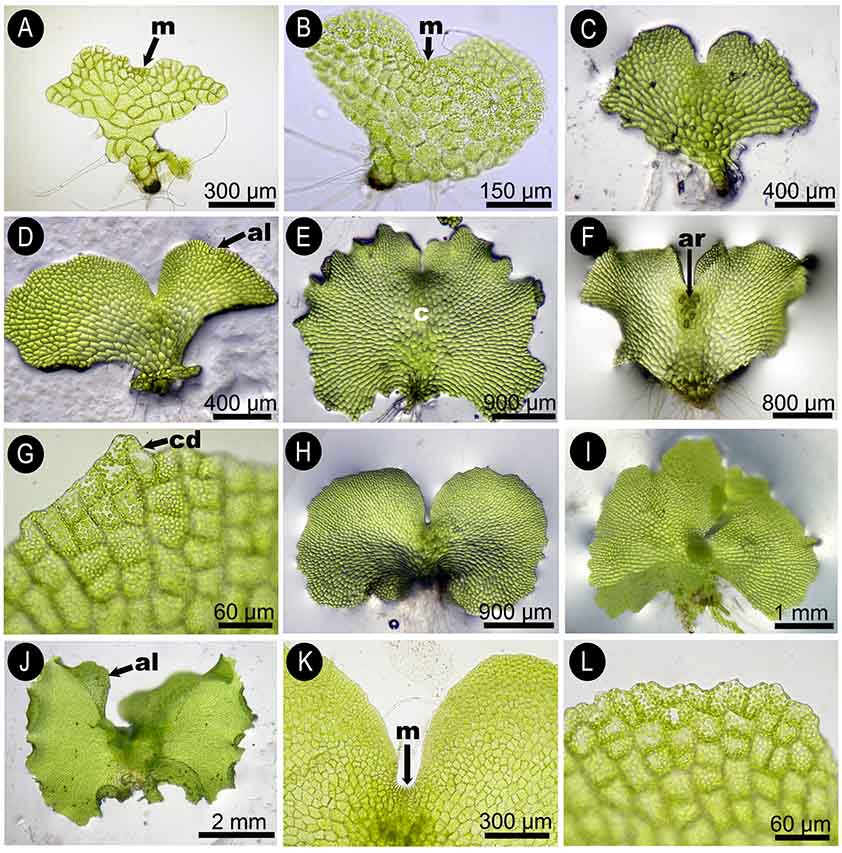
Key results: All taxa had trilete spores and showed Vittaria-type germination. Two types of prothallial development were observed: Adiantum and Ceratopteris. The shape of the adult gametophytes was cordate, spatulate-cordate or cordate-reniform; the margins were smooth, undulate or with two tooth-shaped cells. The sporophytes of P. notabilis, P. ribae, P. sagittata, P. ternifolia and P. villosa were of sexual origin, whereas those of P. cordifolia and P. oaxacana were apogamous. Pellaea sagittata and P. ternifolia developed sporophytes of both sexual and apogamous origins. Pellaea pringlei and a specimen of P. cordifolia did not produce sporophytes.
Conclusions: The development and characteristics of the gametophytes studied were similar to those reported in other studies, obtaining in most species sporophytes of sexual and/or apogamous origin. For the first time, the prothallic development of P. oaxacana, P. ribae and P. villosa is described, providing information for 15 of the 16 species of Pellaea sect. Pellaea occurring in Mexico.
Downloads
References
Adobe. 2008. Adobe Photoshop CS4 extended. Adobe Systems Incorporated. San José, USA. www.adobe.com/products/photoshop.html (consultado junio de 2023).
Alexander, P. J. 2021. Pellaea zygophylla, a new combination for a distinctive & well-known but neglected fern. Journal of Semiarid Environments 2: 1-33. DOI: https://doi.org/10.31219/osf.io/k8sqd DOI: https://doi.org/10.31219/osf.io/k8sqd
Barrington, D. S., C. A. Paris y T. A. Ranker. 1986. Systematic inferences from spore and stomate size in the ferns. American Fern Journal 76 (3): 149-159. DOI: https://doi.org/10.2307/1547723 DOI: https://doi.org/10.2307/1547723
Barrington, D. S., N. R. Patel y M. W. Southgate. 2020. Inferring the impacts of evolutionary history and ecological constraints on spore size and shape in the ferns. Applications in Plant Sciences 8(4): e11339. DOI: https://doi.org/10.1002/aps3.11339 DOI: https://doi.org/10.1002/aps3.11339
Beck, J. B., M. D. Widham y K. M. Pryer. 2011. Do asexual polypoid lineages lead short evolutionary lives? A case study from the fern genus Astrolepis. Evolution 65(11): 3218-3229. DOI: https://doi.org/10.1111/j.1558-5646.2011.01362.x DOI: https://doi.org/10.1111/j.1558-5646.2011.01362.x
Bucharová, A. y Z. Münzbergová. 2012. Gene Flow among Populations of Two Rare Co-occurring Fern Species Differing in Ploidy Level. PLoS ONE 7(9): e45855. DOI: https://doi.org/10.1371/journal.pone.0045855 DOI: https://doi.org/10.1371/journal.pone.0045855
Díaz Espinoza, J. A. 2002. Ciclo biológico de Diplazium lonchophyllum Kunze (Pteridophyta-Woodsiaceae) y Pellaea cordifolia (Sessé & Mociño) A. R. Sm. (Pteridophyta-Pteridaceae). Tesis de licenciatura. Escuela Nacional de Ciencias Biológicas, Instituto Politécnico Nacional. Cd. Mx., México. 94 pp.
Dyer, R. J., J. Pellicer, V. Savolainen, I. J. Leitch y H. Schneider. 2013. Genome size expansion and the relationship between nuclear DNA content and spore size in the Asplenium monanthes fern complex (Aspleniaceae). BMC Plant Biology 13: 219. DOI: https://doi.org/10.1186/1471-2229-13-219 DOI: https://doi.org/10.1186/1471-2229-13-219
Gastony, G. J. y D. R. Rollo. 1995. Phylogeny and generic circumscriptions of cheilanthoid ferns (Pteridaceae: Cheilanthoideae) inferred from rbcL nucleotide sequences. American Fern Journal 85(4): 341-360. DOI: https://doi.org/10.2307/1547814 DOI: https://doi.org/10.2307/1547814
Gastony, G. J. y D. R. Rollo. 1998. Cheilanthoid ferns (Pteridaceae: Cheilanthoideae) in the southwestern United States and adjacent Mexico–– a molecular phylogenetic reassessment of generic lines. Aliso 17: 131-144. DOI: https://doi.org/10.5642/aliso.19981702.04 DOI: https://doi.org/10.5642/aliso.19981702.04
Grusz, A. L. 2016. A current perspective on apomixis in ferns. Journal of Systematics and Evolution 54: 656-665. DOI: https://doi.org/10.1111/jse.12228 DOI: https://doi.org/10.1111/jse.12228
Grusz, A. L., M. D. Windham, K. T. Picard, K. M. Pryer, E. Schuettpelz y C. H. Haufler. 2021. A drought-driven model for the evolution of obligate apomixis in ferns: evidence from pellaeids (Pteridaceae). American Journal of Botany 108(2): 263-283. DOI: https://doi.org/10.1002/ajb2.1611 DOI: https://doi.org/10.1002/ajb2.1611
Haufler, C. H. 2014. Ever since Klekowski: Testing a set of radical hypotheses revives the genetics of ferns and lycophytes. American Journal of Botany 101(12): 2036-2042. DOI: https://doi.org/10.3732/ajb.1400317 DOI: https://doi.org/10.3732/ajb.1400317
Haufler, C. H., K. M. Pryer, E. Schuettpelz, E. B. Sessa, D. F. Farrar, R. Moran, J. J. Schneller, J. E. Watkins y M. D. Windham. 2016. Sex and the single gametophyte: Revising the homosporous vascular plant life cycle in light of contemporary research. BioScience 66(11): 928-937. DOI: https://doi.org/10.1093/biosci/biw108 DOI: https://doi.org/10.1093/biosci/biw108
Hayes, D. W. 1924. Some studies of apogamy in Pellaea atropurpurea (L.) Link. Transactions of American Microscopical Society 43: 119-135. DOI: https://doi.org/10.2307/3221661 DOI: https://doi.org/10.2307/3221661
Henry, T. A., J. D. Bainard y S. G. Newmaster. 2014. Genome size evolution in Ontario ferns (Polypodiidae): evolutionary correlations with cell size, spore size, and habitat type and an absence of genome downsizing. Genome 57(10): 555-566. DOI: https://doi.org/10.1139/gen-2014-0090 DOI: https://doi.org/10.1139/gen-2014-0090
Hernández, M. A., R. A. Andrada, V. A. Páez y O. G. Martínez. 2015. Ploidy level and obligate apogamy in Argyrochosma nivea (Poir.) Windham var. tenera (Pteridaceae). Hoehnea 42(2): 233-237. DOI: https://doi.org/10.1590/2236-8906-36/2014 DOI: https://doi.org/10.1590/2236-8906-36/2014
Herrera-Soriano, A., M. L. Arreguín-Sánchez, S. Rojas-Velasco y L. Á. Lepe-Becerra. 2011. Biología reproductiva de Pellaea ovata (Desv.) Weath. (Pteridaceae-Pteridophyta). Polibotánica 31: 51-59.
Hornych, O., A. Férová, K. Hori, J. Košnar y L. Ekrt. 2022. Apomictic fern fathers: an experimental approach to the reproductive characteristics of sexual, apomict, and hybrid fern gametophytes. American Journal of Botany 109(4): 628-644. DOI: https://doi.org/10.1002/ajb2.1817 DOI: https://doi.org/10.1002/ajb2.1817
Huerta-Zavala, J., M. L. Arreguín-Sánchez, D. Quiroz-García y R. Nava. 2013. Ciclo de vida de Pellaea ternifolia (Cav.) Link subsp. ternifolia (Pteridaceae-Polypodiidae). Polibotánica 35: 65-84.
Kirkpatrick, R. E. B. 2007. Investigating the monophyly of Pellaea (Pteridaceae) in the context of a phylogenetic analysis of Cheilanthoid ferns. Systematic Botany 32(3): 504-518. DOI: https://doi.org/10.1600/036364407782250616 DOI: https://doi.org/10.1600/036364407782250616
Klekowski, E. J. 1969. Reproductive biology of the Pteridophyta. III. A study of the Blechnaceae. Botanical Journal of the Linnean Society 62(3): 361-377. DOI: https://doi.org/10.1111/j.1095-8339.1969.tb01973.x DOI: https://doi.org/10.1111/j.1095-8339.1969.tb01973.x
Knobloch, I. W. 1966. A Preliminary Review of Spore Number and Apogamy within the Genus Cheilanthes. American Fern Journal 56(4): 163-167. DOI: https://doi.org/10.2307/1545934 DOI: https://doi.org/10.2307/1545934
Manton, I. 1950. Problems of cytology and evolution in the pteridophytes. Cambridge University Press. Cambridge, UK. 316 pp. DOI: https://doi.org/10.5962/bhl.title.4667
Mendoza, A., M. Windham, B. Pérez-Garcia y G. Yatskievych. 2001. Una nueva especie de Pellaea (Pteridaceae) del estado de San Luis de Potosí, México. Acta Botanica Mexicana 57: 15-21. DOI: https://doi.org/10.21829/abm57.2001.881 DOI: https://doi.org/10.21829/abm57.2001.881
Mickel, J. T. y A. R. Smith. 2004. The pteridophytes of Mexico. Memoirs of the New York Botanical Garden 88: 1-1054.
Nayar, B. K. y N. Bajpai. 1963. Morphology of the gametophytes of some species of Pellaea and Notholaena. Botanical Journal of the Linnean Society 59(376): 63-76. DOI: https://doi.org/10.1111/j.1095-8339.1964.tb00046.x DOI: https://doi.org/10.1111/j.1095-8339.1964.tb00046.x
Nayar, B. K. y S. Kaur. 1971. Gametophytes of homosporous ferns. Botanical Review (London) 37: 295-396. DOI: https://doi.org/10.1007/BF02859157 DOI: https://doi.org/10.1007/BF02859157
Picard, K. T., H. Ranft, A. L. Grusz, M. D. Windham y E. Schuettpelz. 2021. When it only takes one to tango: assessing the impact of apomixis in the fern genus Pteris. American journal of Botany 108(11): 2220-2234. DOI: https://doi.org/10.1002/ajb2.1761 DOI: https://doi.org/10.1002/ajb2.1761
Pickett, F. L. y M. E. Manuel. 1925. Development of prothallus and apogamous embryo in Pellaea glabella Mettenius. Bulletin of the Torrey Club 52: 507-514. DOI: https://doi.org/10.2307/2480298
PPG I. 2016. A community-based classification for extant ferns and lycophytes. Journal of Systematics and Evolution 54(6): 563-603. DOI: https://doi.org/10.1111/jse.12229 DOI: https://doi.org/10.1111/jse.12229
Pray, T. R. 1968a. The gametophytes of Pellaea section Pellaea: Darkstiped series. Phytomorphology 18: 113-143.
Pray, T. R. 1968b. Interpopulational variation in the gametophytes of Pellaea andromedaefolia. American Journal of Botany 55: 951-960. DOI: https://doi.org/10.1002/j.1537-2197.1968.tb07454.x
Pray, T. R. 1970. The gametophytes of Pellaea section Pellaea: Light-stiped series. Phytomorphology 20: 137-144.
Pray, T. R. 1971. The Gametophytes of Natural Hybrids in the Fern Genus Pellaea. American Fern Journal 61(3): 121-136. DOI: https://doi.org/10.2307/1546643
Raghavan, V. 1989. Developmental biology of fern gametophytes. Cambridge University Press. Cambridge. Pp. 362. DOI: https://doi.org/10.1017/CBO9780511529757 DOI: https://doi.org/10.1017/CBO9780511529757
Rigby, S. J. 1973. lnduction of apogamy in Pellaea glabella var. occidentalis. American Fern Journal 63(4): 158-164. DOI: https://doi.org/10.2307/1546796 DOI: https://doi.org/10.2307/1546796
Sessa, E. B., W. L. Testo y J. E. Watkins Jr. 2016. On the widespread capacity for, and functional significance of, extreme inbreeding in ferns. New Phytology 211(3): 1108-1119. DOI: https://doi.org/10.1111/nph.13985
Steil, W. N. 1911. Apogamy in Pellaea atropurpurea. Botanical Gazette 52: 400-401. DOI: https://doi.org/10.1086/330670
Steil, W. N. 1915. New cases of apogamy in ferns. Preliminary note. Science 41: 293-294. DOI: https://doi.org/10.1126/science.41.1051.293
Steil, W. N. 1918. Studies of some new cases of apogamy in ferns. Bulletin of the Torrey Botanical Club 45(3): 93-108. DOI: https://doi.org/10.2307/2479704
Thiers B. 2023-continuously updated. Index Herbariorum: A Global Directory of Public Herbaria and Associated Staff. New York Botanical Garden’s Virtual Herbarium. Available from http://sweetgum.nybg.org/science/ih/ (consultado junio de 2023).
Tryon, A. F. 1957. A revision of Pellaea section Pellaea. Annals of the Missouri Botanical Garden 44: 125-193. DOI: https://doi.org/10.2307/2394577
Tryon, A. F. 1968. Comparisons of sexual and apogamous races in the fern genus Pellaea. Rhodora 70: 1-24.
Tryon, A. F. 1972. Spores, chromosomes and relations of the fern Pellaea atropurpurea. Rhodora 74: 220-241.
Tryon, R. M. y A. F. Tryon. 1982. Ferns and allied plants, with special reference to tropical America. Springer-Verlag. Nueva York, USA. 857 pp. DOI: https://doi.org/10.1007/978-1-4613-8162-4
Tryon, R. M., A. F. Tryon y K. U. Kramer. 1990. Pteridaceae. In: Kubitzki, K. (ed.). The families and genera of vascular plants 1. Springer-Verlag, Berlin, Heidelberg, Germany. Pp. 230-256. DOI: https://doi.org/10.1007/978-3-662-02604-5 DOI: https://doi.org/10.1007/978-3-662-02604-5_42
Velázquez-Montes, E. 2019. Pteridaceae. Flora del Bajío y de Regiones Adyacentes 210: 1-254. DOI: https://doi.org/10.21829/fb.40.2019.210 DOI: https://doi.org/10.21829/fb.40.2019.210
Wagner, W. H. Jr. 1974. Structure of spores in relation to fern phylogeny. Annals of the Missouri Botanical Garden 61(2): 332-353. DOI: https://doi.org/10.2307/2395061 DOI: https://doi.org/10.2307/2395061
Windham, M. D. y G. Yatskievych. 2003. Revised nomenclature and a new North American record for the villose cliff brake (Pellaea, Pteridophyta). Novon 13(3): 358-362. DOI: https://doi.org/10.2307/3393272 DOI: https://doi.org/10.2307/3393272
Wu, X., A. Yan, S. A. M. McAdam, J. A. Banks, S. Zhang y Y. Zhou. 2021. Timing of meristem initiation and maintenance determines the morphology of fern gametophytes. Journal of Experimental Botany 72(20): 6990-7001. DOI: https://doi.org/10.1093/jxb/erab307 DOI: https://doi.org/10.1093/jxb/erab307
Downloads


Published
How to Cite
-
Abstract1704
-
PDF (Español)325
-
XML (Español)48
-
EPUB (Español)187
Issue
Section
License

This work is licensed under a Creative Commons Attribution-NonCommercial 4.0 International License.
Authors who publish in this journal accept the following conditions:
In accordance with copyright legislation, Acta Botanica Mexicana recognizes and respects the moral rights of authors, as well as the ownership of the patrimonial right, which will be assigned to the journal for its dissemination in open access. Acta Botanica Mexicana does not charge authors for sending and processing articles for publication.
All the texts published by Acta Botanica Mexicana - without exception- are distributed under the Creative Commons 4.0 Attribution-Non Commercial License (CC BY-NC 4.0 International), which allows third parties to use what is published whenever they mention the authorship of the work and the first publication in this journal.
The authors can make other independent and additional contractual agreements for the non-exclusive distribution of the version of the article published in Acta Botanica Mexicana (for example, include it in an institutional repository or publish it in a book) as long as they clearly indicate that the work was published for the first time in Acta Botanica Mexicana
As a consequence, the copyeditors will request you, together with the galley review, to issue your Letter-Transfer of Ownership of Copyright form of the first publication duly completed and signed by the author(s). This letter should be sent by email in pdf file to the email: acta.botanica@inecol.mx (Letter-Transfer of Ownership of Copyright).


