
Potentially harmful phytoplankton species in the Lobos-Tuxpan Reef System, Gulf of Mexico: composition, richness, and cell density
DOI:
https://doi.org/10.21829/abm133.2026.2620Keywords:
coastal ecosystems, coastal influence, phytoplankton assemblages, resident species, toxic potentialAbstract
Background and Aims: Coral reefs, such as those that make up the Lobos-Tuxpan Reef System (SALT), are of great ecological and social importance. Among their main components, yet one of the least studied, is phytoplankton. Within this group, there are species—toxic or otherwise—that can cause harmful algal blooms with detrimental consequences for the socio-ecosystem. The objective of this study was to identify potentially harmful species, estimate their cell density, and characterize environmental conditions in the SALT during two periods of the year.
Methods: Sampling was conducted during the rainy season and the season of trade winds (2024-2025) in the six reefs of the SALT. Environmental variables were measured, water samples were collected from the surface and bottom layers, and phytoplankton net tows (64 µm) were performed. The composition, species richness, and cell density of non-toxigenic and toxigenic species were determined.
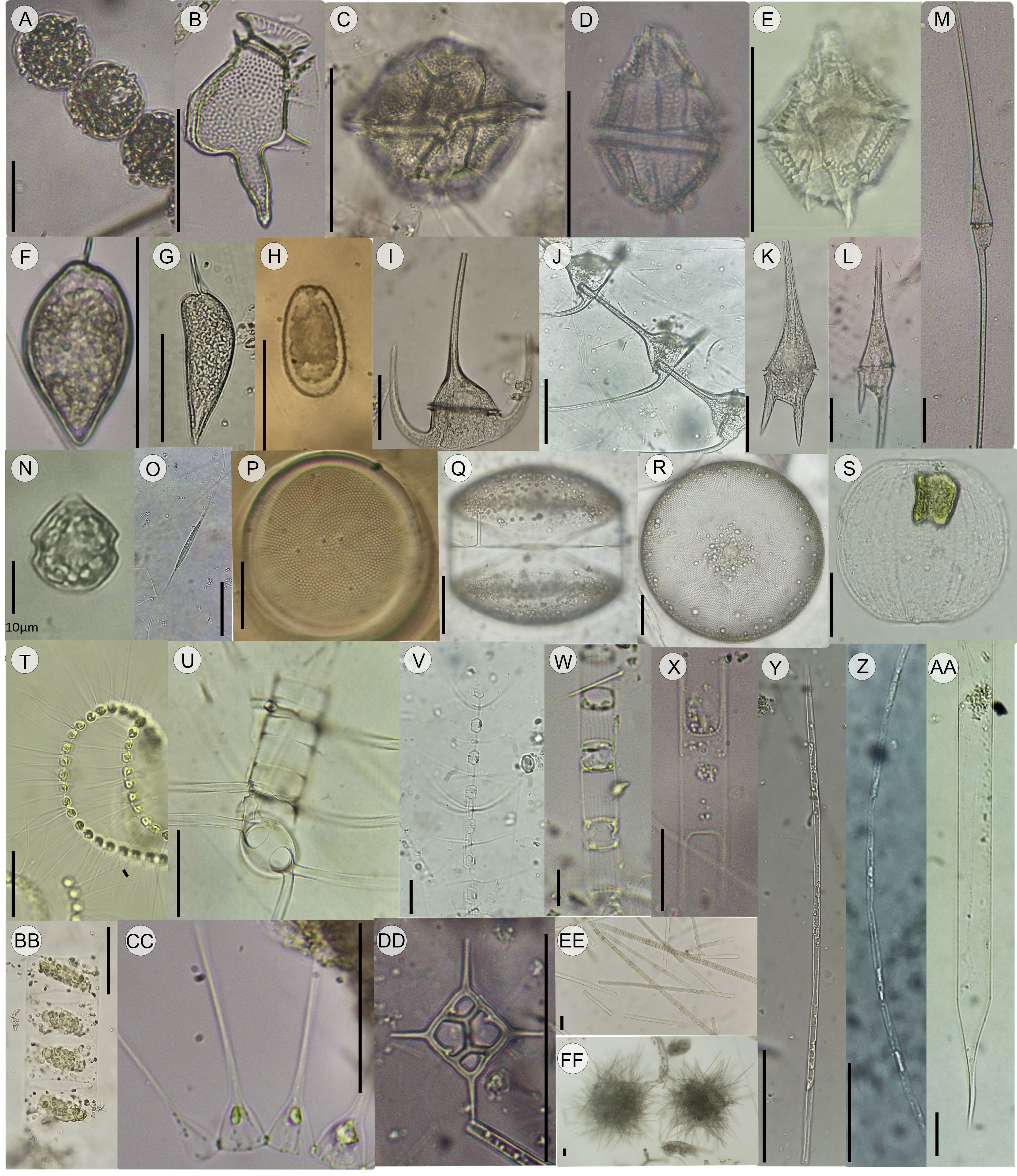
Key results: Thirty-two potentially harmful species were detected, of which 24 were non-toxigenic and eight were potentially toxigenic. Among the non-toxigenic harmful species, some were observed during both seasons, such as Tripos furca var. furca, Tripos fusus, Tripos muelleri, and Tripos dens. Among the species associated with toxin production, Dinophysis caudata, Prorocentrum lima, Pyrodinium bahamense, and genera such as Alexandrium and Pseudo-nitzschia stand out. Cell densities ranged from 59 cells/l to 422 cells/l, and the species with the highest cell density was Cylindrotheca closterium.
Conclusions: The Lobos-Tuxpan Reef System harbors a wealth of potentially harmful species that had not been previously recorded. However, due to their low cell densities, they were not detected in an algal bloom. The abundance of these harmful species remained stable throughout the observation year, suggesting that they are generalist species. Some taxa, such as Dinophysis caudata, Prorocentrum lima, Pyrodinium bahamense, Alexandrium, and Pseudo-nitzschia, are of concern and require monitoring given their toxigenic potential.
Downloads
References
Abad-Aguilar, I. 2015. Riqueza y Sistemática de diatomeas planctónicas y bentónicas durante las estaciones otoño-invierno del arrecife Tuxpan, Veracruz, 2014-2015. Tesis de licenciatura. Universidad Veracruzana. Tuxpan, Veracruz, México. 118 pp.
Aguilar-Medrano, R., M. E. Vega-Cendejas y A. A. Chí-Espínola. 2023. A checklist of dead fishes (Actinopterygii and Elasmobranchii) associated with the algal bloom event of the summer of 2022 on the Yucatan coasts, southern Gulf of Mexico. Acta Ichthyologica et Piscatoria 53: 263-270. DOI: https://doi.org/10.3897/aiep.53.112253 DOI: https://doi.org/10.3897/aiep.53.112253
Ajani, P., M. E. Larsson, A. Rubio, S. Bush, S. Brett y H. Farrell. 2016. Modelling bloom formation of the toxic dinoflagellates Dinophysis acuminata and Dinophysis caudata in a highly modified estuary, southeastern Australia. Estuarine, Coastal and Shelf Science 183(Part A): 95-106. DOI: https://doi.org/10.1016/j.ecss.2016.10.020 DOI: https://doi.org/10.1016/j.ecss.2016.10.020
Aké-Castillo, J. A. 2011. Temporal dynamics of Trichodesmium erythraeum (Cyanophyta) in the National Park “Sistema Arrecifal Veracruzano” in the Gulf of Mexico. Journal of Environmental Biology 32(4): 396-399.
Aké-Castillo, J. A. y C. A Poot-Delgado. 2016. FAN en el Golfo de México: panorama general sobre eventos y especies. In: García-Mendoza, E., S. Quijano-Scheggia, A. Olivos-Ortíz y E. J. Núñez-Vázquez (eds.). Florecimientos Algales Nocivos en México. Centro de Investigación Científica y de Educación Superior de Ensenada (CICESE). Ensenada, México. Pp. 298-307.
Aké-Castillo, J. A. y C. F Rodríguez-Gómez. 2019. El Corredor Arrecifal del Suroeste del Golfo de México y los sistemas de manglar de Veracruz. In: Granados-Barba, A., L. Ortíz-Lozano, C. González-Gándara y D. Salas-Monreal (eds.). Estudios científicos en el Corredor Arrecifal del suroeste del Golfo de México. Universidad Autónoma de Campeche. Campeche, México. Pp. 301-316.
Aké-Castillo, J. A. y C. F. Rodríguez-Gómez. 2025. Diversidad fitoplanctónica en el Corredor Arrecifal del Suroeste del Golfo de México. In: Granados-Barba, A., L. D. Ortiz-Lozano y A. L. Gutiérrez-Velázquez (eds.). Nuevo conocimiento sobre el Corredor Arrecifal del Suroeste del Golfo de México: integrando los ambientes costeros. Universidad Autónoma de Campeche. San Francisco de Campeche, México. Pp. 71-86. DOI: https://doi.org/10.26359/EPOMEX02202502
Aké-Castillo, J. A., A. Almazán-Becerril, C. F. Rodríguez-Gómez y E. García-Mendoza. 2018. Catálogo de microalgas marinas de Veracruz. Centro de Investigación Científica y de Educación Superior de Ensenada (CICESE). Ensenada, México. 162 pp.
Aké-Castillo, J. A., Y. B. Okolodkov, C. F. Rodríguez-Gómez y G. Campos-Bautista. 2014. Florecimientos algales nocivos en Veracruz: especies y posibles causas (2002-2012). In: Botello, A. V., J. Rendón-von Ostén, J. A. Benítez y G. Gold-Bouchot (eds.). Golfo de México. Contaminación e Impacto Ambiental: Diagnóstico y Tendencias. Universidad Autónoma de Campeche (UAC), Universidad Nacional Autónoma de México (UNAM) - Instituto de Ciencias del Mar y Limnología (ICMYL), Centro de Investigación y de Estudios Avanzados del Instituto Politécnico Nacional (CINVESTAV)-Unidad Mérida. Campeche, México. Pp. 133-146.
Almazán-Becerril, A., J. A Aké-Castillo, E. García-Mendoza, Y. A. Sánchez-Bravo, S. Escobar-Morales y F. Valadez-Cruz. 2016a. Catálogo de microalgas de Bahía de Todos Santos, Baja California. Centro de Investigación Científica y de Educación Superior de Ensenada (CICESE). Ensenada, México. 132 pp.
Almazán-Becerril, A., S. Escobar-Morales, E. D. Irola-Sansores y B. Delgado-Pech. 2016b. Morfología y taxonomía de los géneros Ostreopsis y Coolia en el Caribe Mexicano. In: García Mendoza, E., S. Quijano-Scheggia, A. Olivos-Ortíz y E. J. Núñez-Vázquez (eds.). Florecimientos Algales Nocivos en México. Centro de Investigación Científica y de Educación Superior de Ensenada (CICESE). Ensenada, México. Pp. 378-393.
Aminot, A. y F. Rey. 2000. Standard procedure for the determination of chlorophyll a by spectroscopic methods. ICES Techniques in Marine Environmental Sciences. Copenhagen, Denmark. Pp. 1-17.
Anderson, D. M., A. D. Cembella y G. M. Hallegraeff. 2012. Progress in understanding harmful algal blooms: paradigm shifts and new technologies for research, monitoring, and management. Annual Review of Marine Science 4: 143-176. DOI: https://doi.org/10.1146/annurev-marine-120308-081121 DOI: https://doi.org/10.1146/annurev-marine-120308-081121
Ávila-García, D., L. E. Hernández-Salinas, J. Alvarado-Velázquez, A. Rosas-Cruz, F. Cicchini, A. I. Fernández-Montes de Oca y S. López-Ramírez. 2025. Plan de acción para el manejo integral de cuencas hídricas: cuenca río Tuxpan. Instituto Nacional de Ecología y Cambio Climático (INECC) - Fondo Mexicano para la Conservación de la Naturaleza (FMCN), Banco Mundial. Cd. Mx., México. 160 pp.
Barraza, J. E. 2023. Eventos de blanqueamiento del coral Porites lobata (2006-2022) y actividades de restauración en el sitio Ramsar “Complejo Los Cóbanos”, El Salvador. Revista de Biología Tropical 71(S1): e54739. DOI: https://doi.org/10.15517/rev.biol.trop..v71iS1.54739 DOI: https://doi.org/10.15517/rev.biol.trop..v71iS1.54739
Bauman, A. G., J. A. Burt, D. A. Feary, E. Marquis y P. Usseglio. 2010. Tropical harmful algal blooms: An emerging threat to coral reef communities? Marine Pollution Bulletin 60(11): 2117-2122. DOI: https://doi.org/10.1016/j.marpolbul.2010.08.015 DOI: https://doi.org/10.1016/j.marpolbul.2010.08.015
Bergman, B., G. Sandh, S. Lin, J. Larsson y E. J. Carpenter. 2013. Trichodesmium–a widespread marine cyanobacterium with unusual nitrogen fixation properties. FEMS Microbiology Reviews 37(3): 286-302. DOI: https://doi.org/10.1111/j.1574-6976.2012.00352.x DOI: https://doi.org/10.1111/j.1574-6976.2012.00352.x
Bernardi Aubry, F., F. Acri, M. Bastianini, S. Finotto y A. Pugnetti. 2022. Differences and similarities in the phytoplankton communities of two coupled transitional and marine ecosystems (the Lagoon of Venice and the Gulf of Venice - Northern Adriatic Sea). Frontiers in Marine Science 9: 974967. DOI: https://doi.org/10.3389/fmars.2022.974967 DOI: https://doi.org/10.3389/fmars.2022.974967
Carreón-Palau, L., C. C. Parrish, J. A. Del Angel-Rodríguez y H. Pérez-España. 2021. Seasonal shifts in fatty acids and sterols in sponges, corals, and bivalves, in a southern Gulf of Mexico coral reef under river influence. Coral Reefs 40: 571-593. DOI: https://doi.org/10.1007/s00338-020-02042-1 DOI: https://doi.org/10.1007/s00338-020-02042-1
COFEPRIS. 2016. Lineamiento de trabajo para el muestreo de fitoplancton y detección de biotoxinas marinas. Secretaría de Salud, Comisión Federal para la Protección contra Riesgos Sanitarios. Cd. Mx., México. 24 pp.
De la Lanza Espino, G., N. Sánchez-Santillán y A. Esquivel-Herrera. 1998. Análisis temporal y espacial fisicoquímico de una laguna tropical a través del análisis multivariado. Hidrobiológica 8(2): 89-96.
DOF. 2009. Decreto por el que se declara área natural protegida, con el carácter de Área de Protección de Flora y Fauna, la región conocida como Sistema Arrecifal Lobos-Tuxpan, localizada frente a las costas de los municipios de Tamiahua y Tuxpan, en el Estado de Veracruz. Diario Oficial de la Federación. Cd. Mx., México. 6 pp.
DOF. 2014. Acuerdo por el que se da a conocer el resumen del Programa de Manejo del Área de Protección de Flora y Fauna Sistema Arrecifal Lobos-Tuxpan. Diario Oficial de la Federación. Cd. Mx., México. 44 pp.
Ezzat, L., J. F. Maguer, R. Grover y C. Ferrier-Pagès. 2016. Limited phosphorus availability is the Achilles heel of tropical reef corals in a warming ocean. Scientific Reports 6: 31768. DOI: https://doi.org/10.1038/srep31768 DOI: https://doi.org/10.1038/srep31768
Gajski, G., M. Gerić, A. Baričević y M. Smodlaka Tanković. 2024. Domoic acid: A review of its cytogenotoxicity within the One Health approach. Antioxidants 13(11): 1366. DOI: https://doi.org/10.3390/antiox13111366 DOI: https://doi.org/10.3390/antiox13111366
Gárate-Lizárraga, I. y G. M. Esqueda-Escárcega. 2016. Proliferation of Falcula hialina and Cylindrotheca closterium (Bacillariophyceae) on copepods in Bahía de La Paz, Gulf of California, Mexico. Revista de Biología Marina y Oceanografía 51(1): 197-201. DOI: https://doi.org/10.4067/S0718-19572016000100021 DOI: https://doi.org/10.4067/S0718-19572016000100021
Gárate-Lizárraga, I. y R. E. Muciño-Márquez. 2012. Blooms of Trichodesmium erythraeum and T. thiebautii (Cyanobacteria, Oscillatoriales) in the Bahía de la Paz, Gulf of California. CICIMAR Oceánides 27(1): 61-64. DOI: https://doi.org/10.37543/oceanides.v27i1.110 DOI: https://doi.org/10.37543/oceanides.v27i1.110
Gobler, C. J. 2020. Climate Change and Harmful Algal Blooms: Insights and perspective. Harmful Algae 91: 101731. DOI: https://doi.org/10.1016/j.hal.2019.101731 DOI: https://doi.org/10.1016/j.hal.2019.101731
Guiry, M. D. y G. M. Guiry. 2026. AlgaeBase. World-wide electronic publication, University of Galway. https://www.algaebase.org (consultado mayo de 2026).
Hasle, G. 1978. The inverted microscope method. In: Sournia, A. (ed.). Phytoplankton Manual. Paris, France. Pp. 88-96.
Horta-Puga, G. 2010. Impactos Ambientales. In: Tunnell Jr, J. W., E. A Chávez, K. Withers (eds.). Arrecifes Coralinos del Sur del Golfo de México. Centro Interdisciplinario de Ciencias Marinas - Instituto Politécnico Nacional (CICIMAR-IPN). La Paz, México. Pp. 183-236.
Irola-Sansores, E. D., B. Delgado-Pech y A. Almazán-Becerril. 2020. Abundancia del género Gambierdiscus en diferentes especies de macroalgas en el Caribe mexicano. In: Pérez-Morales, A., J. A. Aké-Castillo y C. A. Poot-Delgado (eds.). Investigaciones Marinas en el Golfo de México y Mar Caribe mexicano. Universidad de Colima. Colima, México. Pp. 133-152.
Johnson, B., M. Richlen, J. Lai y M. J. Twiner. 2026. “Algal-dromes”: a novel conceptual approach to illness in humans exposed to harmful algal bloom toxins. Frontiers in Toxicology 8: 1749427. DOI: https://doi.org/10.3389/ftox.2026.1749427 DOI: https://doi.org/10.3389/ftox.2026.1749427
Lan, J., P. Liu, X. Hu, y S. Zhu. 2024. Harmful Algal Blooms in Eutrophic Marine Environments: Causes, Monitoring, and Treatment. Water 16(17): 2525. DOI: https://doi.org/10.3390/w16172525 DOI: https://doi.org/10.3390/w16172525
Lassus, P., N. Chomérat, P. Hess y E. Nézan. 2016. Toxic and harmful microalgae of the World Ocean. International Society for the Study of Harmful Algae (ISSHA), Intergovernmental Oceanographic Commission (IOC)-UNESCO. Copenhagen, Denmark. 523 pp.
Lesser, M. P. 2021. Eutrophication on coral reefs: what is the evidence for phase shifts, nutrient limitation and coral bleaching. BioScience 71(12): 1216-1233. DOI: https://doi.org/10.1093/biosci/biab101 DOI: https://doi.org/10.1093/biosci/biab101
Limbu, S. M. y M. S. Kyewalyanga. 2015. Spatial and temporal variations in environmental variables in relation to phytoplankton composition and biomass in coral reef areas around Unguja, Zanzibar, Tanzania. SpringerPlus 4: 646 DOI: https://doi.org/10.1186/s40064-015-1439-z DOI: https://doi.org/10.1186/s40064-015-1439-z
Lundholm, N., C. Bernard, C. Churro, L. Escalera, M. Hoppenrath, M. Iwataki, J. Larsen, K. Mertens, S. Murray, I. Probert, R. Salas, U. Tillmann y A. Zingone. 2009. IOC-UNESCO Taxonomic Reference List of Harmful Microalgae. DOI: https://doi.org/10.14284/362
Lundholm, N., Ø. Moestrup, G. R. Hasle y K. Hoef-Emden. 2003. A study of the Pseudo-nitzschia pseudodelicatissima/cuspidata complex (Bacillariophyceae): What is P. pseudodelicatissima? Journal of Phycology 39(4): 797-813. DOI: https://doi.org/10.1046/j.1529-8817.2003.02031.x DOI: https://doi.org/10.1046/j.1529-8817.2003.02031.x
Martínez-Cruz, M. E., Y. B. Okolodkov, A. C. Aguilar-Trujillo y J. A. Herrera-Silveira. 2015. Epiphytic dinoflagellates on the seagrass Thalassia testudinum at Dzilam, southeastern Gulf of Mexico. Cymbella 1(3): 2-9.
McGowan, S. 2023. Harmful algal blooms. In: Sivanpillai R. (ed.). Biological and environmental hazards, risks, and disasters. Elsevier. Laramie, USA. Pp 9-53. DOI: https://doi.org/10.1016/B978-0-12-820509-9.00002-2 DOI: https://doi.org/10.1016/B978-0-12-820509-9.00002-2
Méndez-Torres, J., R. I. Hernández-Herrera, A. Almazán-Becerril, P. San Martin-Del Angel y B. Delgado-Pech. 2020. Abundancia del género Pseudo-nitzschia en la zona costera de Tuxpan, Veracruz. In: Pérez-Morales, A., J. A. Aké-Castillo, C. A. Poot-Delgado (eds.). Investigaciones marinas en el Golfo de México y Mar Caribe mexicano. Universidad de Colima. Colima, México. Pp. 110-132.
Merino-Virgilio, F. C., Y. B. Okolodkov, A. C. Aguilar-Trujillo, I. Osorio-Moreno, L. Ector y J.A. Herrera-Silveira. 2014. Florecimientos de Cylindrotheca closterium (Bacillariophyceae) en el norte de Yucatán (2001-2014). In: Resúmenes Del XXI Congreso Nacional de Ciencia y Tecnología Del Mar. Isla Cozumel, México.
Merino-Virgilio, F. C., Y. B. Okolodkov, A. C. Aguilar-Trujillo, I. Osorio-Moreno, L. Ector y J. A. Herrera-Silveira. 2019. Blooms caused by the diatom Cylindrotheca closterium along the northern coast of Yucatan, southeastern Gulf of Mexico (2001-2014). In: Kovács, A. y P. Nagy (eds.). Advances in Marine Biology. Nova Science Publishers. Hauppauge, Nueva York, USA. Pp. 57-72.
Morquecho, L. 2019. Pyrodinium bahamense one the most significant harmful dinoflagellate in Mexico. Frontiers in Marine Science 6(1): 1-8. DOI: https://doi.org/10.3389/fmars.2019.00001 DOI: https://doi.org/10.3389/fmars.2019.00001
Muciño-Márquez, R. E., I. Gárate-Lizárraga y D. J. López-Cortés. 2018. Variación estacional del género Prorocentrum (Dinophyceae) en dos granjas atuneras en la Bahía de la Paz, México. Acta Biológica Colombiana 20(1): 195-206. DOI: https://doi.org/10.15446/abc.v20n1.42442 DOI: https://doi.org/10.15446/abc.v20n1.42442
Navarrete-Bautista, M. A., y C. F. Rodríguez-Gómez. 2025. Listado de especies del fitoplancton marino y costero de la zona norte del estado de Veracruz. Cymbella 11(1): 04-46. DOI: https://doi.org/10.22201/fc.24488100e.2025.11.1.1
Okolodkov, Y. B. 2010. Ceratium Schrank (Dinophyceae) of the National Park Sistema Arrecifal Veracruzano, Gulf of Mexico, with a key for identification. Acta Botanica Mexicana 93: 41-101. DOI: https://doi.org/10.21829/abm93.2010.275 DOI: https://doi.org/10.21829/abm93.2010.275
Okolodkov, Y. B. 2014. Dinophysiales (Dinophyceae) of the National Park Sistema Arrecifal Veracruzano, Gulf of Mexico, with a key for identification. Acta Botanica Mexicana 106: 9-71. DOI: https://doi.org/10.21829/abm106.2014.217 DOI: https://doi.org/10.21829/abm106.2014.217
Okolodkov, Y. B., G. Campos-Bautista, I. Gárate-Lizárraga, J. A. G. González-González, M. Hoppenrath y V. Arenas. 2007. Seasonal changes of benthic and epiphytic dinoflagellates in the Veracruz reef zone, Gulf of Mexico. Aquatic Microbial Ecology 47: 223-237. DOI: https://doi.org/10.3354/ame047223 DOI: https://doi.org/10.3354/ame047223
Omura, T., M. Iwataki, T. M. Borja, H. Takayama y Y. Fukuyo. 2012. Marine Phytoplankton of the Western Pacific. Kouseisha Kouseikaku. Tokyo, Japan. 160 pp.
Orduña-Medrano, R. E. 2012. Patrones de distribución y abundancia del fitoplancton nocivo en la zona costera de Tuxpan Veracruz, México. Tesis de maestría. Universidad Veracruzana. Tuxpan, México. 200 pp.
Palmer, C., C. Jimenez, G. Bassey, E. Ruiz, T. Villalobos-Cubero, M. M. Chavarria-Diaz, X. A. Harrison y R. Puschendorf. 2022. Cold water and harmful algal blooms linked to coral reef collapse in the Eastern Tropical Pacific. PeerJ 10: e14081. DOI: https://doi.org/10.7717/peerj.14081 DOI: https://doi.org/10.7717/peerj.14081
Paredes-Flores, J., R. Hernández-Herrera, E. García-Mendoza y E. Zarza-Meza. 2026. Evaluation of marine biotoxins in Crassostrea virginica in Tampamachoco Lagoon and Tamiahua Lagoon, Veracruz. Abanico Boletín Técnico 5: 1-15. DOI: https://doi.org/10.21929/abanicoboletin/2026.8 DOI: https://doi.org/10.21929/abanicoboletin/2026.8
Parsons, M. L., Y. B. Okolodkov y J. A. Aké-Castillo. 2012. Diversidad y morfología de las especies de Pseudo-nitzschia (Bacillariophyta) del Parque Nacional Sistema Arrecifal Veracruzano, suroeste del Golfo de México. Acta Botanica Mexicana 98: 51-72. DOI: https://doi.org/10.21829/abm98.2012.1140 DOI: https://doi.org/10.21829/abm98.2012.1140
Pérez-Morales, A., J. A. Aké-Castillo, Y. B. Okolodkov y G. Campos-Bautista. 2015. Florecimientos algales nocivos y eutrofización frente a la costa del Puerto de Veracruz, suroeste del Golfo de México. Revista digital E-Bios 2(8): 21-33.
Pérez-Olmedo, L. 2017. Composición y abundancia de especies tóxicas y nocivas de dinoflagelados causantes de mareas rojas en la zona costera de Tuxpan, Veracruz Tesis de maestría. Universidad Veracruzana. Tuxpan, México. 89 pp.
Poot-Delgado, C. A. y A. Pérez-Morales. 2023. Variación espaciotemporal del fitoplancton nocivo en playas recreativas de Campeche, sureste del Golfo de México. Ciencias Marinas 49: e3389. DOI: https://doi.org/10.7773/cm.y2023.3389 DOI: https://doi.org/10.7773/cm.y2023.3389
Poot-Delgado, C. A., J. Rendon-von Ostén y Y. B. Okolodkov. 2025. Annual cycle of potentially harmful phytoplankton in the coastal waters of Campeche, southern Gulf of Mexico. Regional Studies in Marine Science 89: 104392. DOI: https://doi.org/10.1016/j.rsma.2025.104392 DOI: https://doi.org/10.1016/j.rsma.2025.104392
Poot-Delgado, C. A., P. I. Rosado-García y Y. A. Guzmán-Noz. 2014. Fitoplancton marino potencialmente nocivo en las aguas costeras de Campeche. In: Botello, A. V., J. Rendon-von Ostén, J. A. Benítez y G. Gold-Bouchot (eds.). Golfo de México. Contaminación e impacto ambiental: diagnóstico y tendencias. Universidad Autónoma de Campeche (UAC), Universidad Autónoma de México, Instituto de Ciencias del Mar y Limnología (UNAM-ICMYL), Centro de Investigación y de Estudios Avanzados del Instituto Politécnico Nacional (CINVESTAV)-Unidad Mérida. Campeche, México. Pp. 117-132.
Pulido, O. M. 2016. Phycotoxins by Harmful Algal Blooms (HABS) and human poisoning: an overview. International Clinical Pathology Journal 2: 145-152. DOI: https://doi.org/10.15406/icpjl.2016.02.00062 DOI: https://doi.org/10.15406/icpjl.2016.02.00062
Racault, M. F., D. E. Raitsos, M. L. Berumen, R. J. W. Brewin, T. Platt, S. Sathyendranath y I. Hoteit. 2015. Phytoplankton phenology indices in coral reef ecosystems: Application to ocean-color observations in the Red Sea. Remote Sensing of Environment 160: 222-234. DOI: https://doi.org/10.1016/j.rse.2015.01.019 DOI: https://doi.org/10.1016/j.rse.2015.01.019
R Core Team. 2024. R: A Language and Environment for Statistical Computing_. R Foundation for Statistical Computing, Vienna, Austria. https://www.R-project.org (consultado marzo de 2026).
Raj, K. D., G. Mathews, D.O. Obura, R. L. Laju, M. S. Bharath, P. D. Kumar, A. Arasamuthu, T. K. A. Kumar y J. K. P. Edward. 2020. Low oxygen levels caused by Noctiluca scintillans bloom kills corals in Gulf of Mannar, India. Scientific Reports 10: 22133. DOI: https://doi.org/10.1038/s41598-020-79152-x DOI: https://doi.org/10.1038/s41598-020-79152-x
Reid, F. M. H. 1978. Permanent records. In: Sournia, A. (ed.). Phytoplankton Manual. United Nations Educational, Scientific and Cultural Organization (UNESCO). Paris, France. Pp. 113-124.
Roberts, S. D., P. D. Van Ruth, C. Wilkinson, S. S. Bastianello y M. S. Bansemer. 2019. Marine Heatwave, Harmful Algae Blooms and an Extensive Fish Kill Event During 2013 in South Australia. Frontiers in Marine Science 6: 610. DOI: https://doi.org/10.3389/fmars.2019.00610 DOI: https://doi.org/10.3389/fmars.2019.00610
Rodríguez-Gómez, C. F., J. A. Aké-Castillo, G. Campos-Bautista y Y. B. Okolodkov. 2015. Revisión del estudio del fitoplancton en el Parque Nacional Sistema Arrecifal Veracruzano. Revista digital E-Bios 2(8): 178-191.
Rodríguez-Gómez, C. F., G. Vásquez y J. A. Aké-Castillo. 2020. Condiciones fisicoquímicas en la columna de agua durante los florecimientos algales del suroeste del Golfo de México (2016-2017). In: Pérez-Morales, A., J. A. Aké-Castillo y C. A. Poot-Delgado (eds.). Investigaciones Marinas en el Golfo de México y Mar Caribe mexicano. Universidad de Colima. Colima, México. Pp. 84-109.
Sathishkumar, R. S., A. Sundaramanickam, G. Sahu, A. K. Mohanty, T. Ramesh y S. A. Khan. 2021. Intense bloom of the diatom Hemidiscus hardmanianus (Greville) in relation to water quality and plankton communities in Tuticorin coast, Gulf of Mannar, India. Marine Pollution Bulletin 163: 111757. DOI: https://doi.org/10.1016/j.marpolbul.2020.111757 DOI: https://doi.org/10.1016/j.marpolbul.2020.111757
Salas-Pérez, J. J. y A. Granados-Barba. 2008. Oceanographic characterization of the Veracruz reefs system. Atmósfera 21: 281-301.
Santavy, D. L., C. L. Horstmann, L. M. Sharpe, S. H. Yee y P. Ringold. 2021. What is it about coral reefs? Translation of ecosystem goods and services relevant to people and their well‐being. Ecosphere 12(8): e03639. DOI: https://doi.org/10.1002/ecs2.3639 DOI: https://doi.org/10.1002/ecs2.3639
SMN. 2023. Calendario de temporadas y Fenómenos Meteorológicos para el Estado de Veracruz. Servicio Meteorológico Nacional. https://www.veracruz.gob.mx/proteccioncivil/wpcontent/uploads/sites/5/2023/02/Calendario-Temporadas.pdf (consultado junio de 2024).
Spaulding, S. A., M. G. Potapova, I. W. Bishop, S. S. Lee, T. S. Gasperak, E. Jovanoska, P. C. Furey y M. B. Edlund. 2021. Diatoms.org: supporting taxonomists, connecting communities. Diatom Research 36(4): 291-304. DOI: https://doi.org/10.1080/0269249X.2021.2006790 DOI: https://doi.org/10.1080/0269249X.2021.2006790
Steidinger, K. A., M. A. Faust y D.U. Hernández-Becerril. 2009. Dinoflagellates (Dinoflagellata) of the Gulf of Mexico. In: Felder, D. L. y D. K. Camp (eds.). Gulf of Mexico-Origins, Waters, and Biota. Biodiversity. Texas A&M University Press. College Station, USA. Pp. 131-154.
Subramanian, A. y A. Purushothaman. 1985. Mass mortality of fish and invertebrates associated with a bloom of Hemidiscus hardmannianus (Bacillariophyceae) in Parangipettai (southern India). Limnology & Oceanography 30: 910-911. DOI: https://doi.org/10.4319/lo.1985.30.4.0910 DOI: https://doi.org/10.4319/lo.1985.30.4.0910
Tangen, K. 1978. Nets. In: Sournia, A. (ed.). Phytoplankton Manual. United Nations Educational, Scientific and Cultural Organization (UNESCO). Paris, France. Pp. 50-58.
Throndsen, J. 1978. Preservation and storage. In: Sournia, A. (ed.). Phytoplankton Manual. United Nations Educational, Scientific and Cultural Organization (UNESCO). Paris, France. Pp. 69-74.
Tillmann, U. y U. John. 2002. Toxic effects of Alexandrium spp. on heterotrophic dinoflagellates: an allochemical defence mechanism independent of PSP-toxin content. Marine Ecology Progress Series 230: 47-58. DOI: https://doi.org/10.3354/meps230047 DOI: https://doi.org/10.3354/meps230047
Ulloa, M. J., P. Álvarez-Torres, K. P. Horak-Romo y R. Ortega-Izaguirre. 2017. Harmful algal blooms and eutrophication along the Mexican coast of the Gulf of Mexico large marine ecosystem. Environmental Development 22: 120-128. DOI: https://doi.org/10.1016/j.envdev.2016.10.007 DOI: https://doi.org/10.1016/j.envdev.2016.10.007
Wells, M. L., V. L. Trainer, T. J. Smayda, B. S. O. Karlson, C. G. Trick, R. M. Kudela, A. Ishikawa, S. Bernard, A. Wulff, D. M. Anderson y W. P. Cochlan. 2015. Harmful algal blooms and climate change: Learning from the past and present to forecast the future. Harmful Algae 49: 68-93. DOI: https://doi.org/10.1016/j.hal.2015.07.009 DOI: https://doi.org/10.1016/j.hal.2015.07.009
Wotton, R. S. 1994. The classification of particulate and dissolved matter. In: Wotton, R.S. (ed.). The biology of particles in aquatic systems. Taylor & Francis. Boca Raton, USA. Pp. 1-6. DOI: https://doi.org/10.1201/9781003070146-1
Zamudio-Reséndiz, M. E. 1998. Hidrología y fitoplancton en una región costera al oeste del Golfo de México. Tesis de maestría. Universidad Nacional Autónoma de México. Cd. Mx., México. 72 pp.
Downloads


Published
How to Cite
-
Abstract250
-
PDF (Español)62
-
EPUB (Español)16
Issue
Section
License

This work is licensed under a Creative Commons Attribution-NonCommercial 4.0 International License.
Authors who publish in this journal accept the following conditions:
In accordance with copyright legislation, Acta Botanica Mexicana recognizes and respects the moral rights of authors, as well as the ownership of the patrimonial right, which will be assigned to the journal for its dissemination in open access. Acta Botanica Mexicana does not charge authors for sending and processing articles for publication.
All the texts published by Acta Botanica Mexicana - without exception- are distributed under the Creative Commons 4.0 Attribution-Non Commercial License (CC BY-NC 4.0 International), which allows third parties to use what is published whenever they mention the authorship of the work and the first publication in this journal.
The authors can make other independent and additional contractual agreements for the non-exclusive distribution of the version of the article published in Acta Botanica Mexicana (for example, include it in an institutional repository or publish it in a book) as long as they clearly indicate that the work was published for the first time in Acta Botanica Mexicana
As a consequence, the copyeditors will request you, together with the galley review, to issue your Letter-Transfer of Ownership of Copyright form of the first publication duly completed and signed by the author(s). This letter should be sent by email in pdf file to the email: acta.botanica@inecol.mx (Letter-Transfer of Ownership of Copyright).


