
Floral visitors of Mormodes maculata (Orchidaceae, Catasetinae) and pollinarium placement on a specialized orchid bee
DOI:
https://doi.org/10.21829/abm133.2026.2643Keywords:
Euglossini bees, floral laterization, perfume orchid, pollinationAbstract
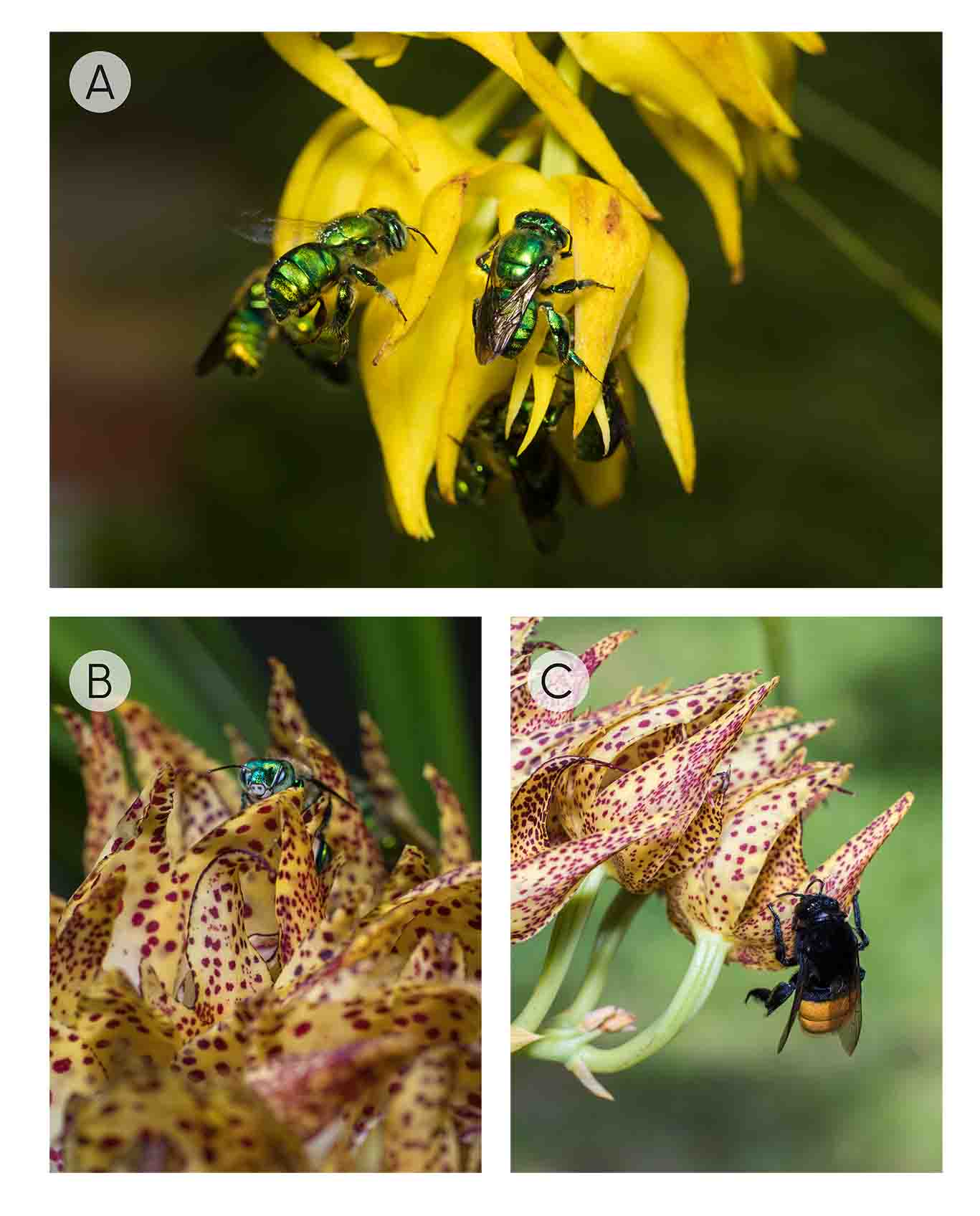
Background and Aims: Mormodes is the only orchid genus exhibiting floral handedness (enantiostyly), a trait presumed to promote cross-pollination. Despite this unique floral morphology, little is known about its reproductive biology or pollinators. The aim of this study was to characterize the floral visitors of two varieties of Mormodes maculata and assess the subsequent positioning of their pollinarium.
Methods: We conducted field observations on 12 flowering individuals of Mormodes maculata representing two floral varieties, M. maculata var. maculata and M. maculata var. unicolor. We observed, captured, and identified floral visitors and documented the specific body region of the bee where the pollinia were attached.
Key results: We identified Euglossa obrima as the pollinator of Mormodes maculata after observing an individual carrying a laterally attached pollinarium, consistent with the flower’s handedness. We also recorded Eulaema polychroma as an occasional floral visitor, exclusively to M. maculata var. maculata, but without evidence of effective pollination.
Conclusions: Our findings reveal a highly specialized pollination mechanism in Mormodes maculata, driven by the interaction between floral handedness and a specialized orchid bee. This high degree of specialization should be considered when developing conservation strategies for the species.
Downloads
References
Ackerman, J. D., R. D. Phillips, R. L. Tremblay, A. Karremans, N. Reiter, C. I. Peter, D. Bogarín, O. A. Pérez-Escobar and H. Liu. 2023. Beyond the various contrivances by which orchids are pollinated: global patterns in orchid pollination biology. Botanical Journal of the Linnean Society 202(3): 295-324. DOI: https://doi.org/10.1093/botlinnean/boac082 DOI: https://doi.org/10.1093/botlinnean/boac082
Ackerman, J. D. and D. W. Roubik. 2012. Can extinction risk help explain plant-pollinator specificity among euglossine bee pollinated plants? Oikos 121(11): 1821-1827. DOI: https://doi.org/10.1111/j.1600-0706.2011.20193.x DOI: https://doi.org/10.1111/j.1600-0706.2011.20193.x
Almeida, N. M. and C. C. de Castro. 2019. Enantiostyly in angiosperms. In: Bahadur, B., K. V. Krishnamurthy, M. Ghose and S. J. Adams (eds.). Asymmetry in Plants: Biology of Handedness. CRC Press. Florida, USA. Pp. 319-328. DOI: https://doi.org/10.1201/9780429492372-20
Barrett, S. C. and A. L. Fairnie. 2024. The neglected floral polymorphism: mirror-image flowers emerge from the shadow of heterostyly. Evolutionary Journal of the Linnean Society 3(1): kzae004. DOI: https://doi.org/10.1093/evolinnean/kzae004 DOI: https://doi.org/10.1093/evolinnean/kzae004
Brandt, K., I. C. Machado, D. M. D. A. F. Navarro, S. Dötterl, M. Ayasse and P. Milet-Pinheiro. 2020. Sexual dimorphism in floral scents of the neotropical orchid Catasetum arietinum and its possible ecological and evolutionary significance. AoB Plants 12(4): plaa030. DOI: https://doi.org/10.1093/aobpla/plaa030 DOI: https://doi.org/10.1093/aobpla/plaa030
Castro, J. B. and R. B. Singer. 2019. A literature review of the pollination strategies and breeding systems in Oncidiinae orchids. Acta Botanica Brasilica 33(4): 618-643. DOI: https://doi.org/10.1590/0102-33062019abb0111
Dalsgaard, B., K. Trøjelsgaard, A. M. Martín González, D. Nogués-Bravo, J. Ollerton, T. Petanidou, B. Sandel, M. Schleuning, Z. Wang, C. Rahbek, W. J. Sutherland, J. Svenning and J. M. Olesen. 2013. Historical climate-change influences modularity and nestedness of pollination networks. Ecography 36(12): 1331-1340. DOI: https://doi.org/10.1111/j.1600-0587.2013.00201.x DOI: https://doi.org/10.1111/j.1600-0587.2013.00201.x
Darwin, C. 1877. The various contrivances by which orchids are fertilised by insects. John Murray. D. Appleton & Company. New York, USA. 300 pp. DOI: https://doi.org/10.5962/bhl.title.60877
Dodson, C. H. 1962. Pollination and Variation in the Subtribe Catasetinae (Orchidaceae). Annals of the Missouri Botanical Garden 49: 35-56. DOI: https://doi.org/10.2307/2394740 DOI: https://doi.org/10.2307/2394740
Domingos-Melo, A., D. M. Silva and P. Milet-Pinheiro. 2025. Floral Handedness in Mormodes Orchids: Revisiting Charles Darwin’s Observations. Biotropica 57(6): e70111. DOI: https://doi.org/10.1111/btp.70111 DOI: https://doi.org/10.1111/btp.70111
Dressler, R. L. 1967. Observations on Orchids and Euglossine Bees in Panama and Costa Rica. Revista de Biologia Tropical 15(1): 143-183.
Dressler, R. L. 1968. Pollination by Euglossine Bees. Evolution 22: 202-210. DOI: https://doi.org/10.2307/2406664 DOI: https://doi.org/10.1111/j.1558-5646.1968.tb03463.x
Gutiérrez-Rodríguez, B. E. and Á. Hernández-Rivera. 2022. The orchids of Megaméxico and their interactions with pollinators. Agro Productividad 15(12): 147-159. DOI: https://doi.org/10.32854/agrop.v15i12.2469
Henske, J., N. W. Saleh, T. Chouvenc, S. R. Ramírez and T. Eltz. 2023. Function of environment-derived male perfumes in orchid bees. Current Biology 33(10): 2075-2080.e3. DOI: https://doi.org/10.1016/j.cub.2023.03.060 DOI: https://doi.org/10.1016/j.cub.2023.03.060
Hetherington-Rauth, M. C. and S. R. Ramírez. 2015. Evolutionary Trends and Specialization in the Euglossine Bee-pollinated Orchid Genus Gongora. Annals of the Missouri Botanical Garden 100: 271-299. DOI: https://doi.org/10.3417/2014035 DOI: https://doi.org/10.3417/2014035
Hetherington-Rauth, M. C. and S. R. Ramírez. 2016. Evolution and diversity of floral scent chemistry in the euglossine bee-pollinated orchid genus Gongora. Annals of Botany 118(1): 135-148. DOI: https://doi.org/10.1093/aob/mcw072 DOI: https://doi.org/10.1093/aob/mcw072
Hills, H. G., N. H. Williams and C. H. Dodson. 1972. Floral Fragrances and Isolating Mechanisms in the Genus Catasetum (Orchidaceae). Biotropica 4: 61-76. DOI: https://doi.org/10.2307/2989728 DOI: https://doi.org/10.2307/2989728
Hinojosa-Díaz, I. A., G. A. Melo and M. S. Engel. 2011. Euglossa obrima, a new species of orchid bee from Mesoamerica, with notes on the subgenus Dasystilbe Dressler (Hymenoptera, Apidae). ZooKeys 97: 11-29. DOI: https://doi.org/10.3897/zookeys.97.1106 DOI: https://doi.org/10.3897/zookeys.97.1106
Liu, J. W., F. Etl, M. F. Otárola, A. P. Karremans and S. R. Ramírez. 2025. The Evolution and Ecology of Specialized Mutualisms Between Perfume Flowers and Male Euglossine Bees. Annual Review of Ecology, Evolution, and Systematics 56: 241-264. DOI: https://doi.org/10.1146/annurev-ecolsys-102723-064710 DOI: https://doi.org/10.1146/annurev-ecolsys-102723-064710
Milet-Pinheiro, P. and G. Gerlach. 2017. Biology of the Neotropical orchid genus Catasetum: A historical review on floral scent chemistry and pollinators. Perspectives in Plant Ecology, Evolution and Systematics 27: 23-34. DOI: https://doi.org/10.1016/j.ppees.2017.05.004 DOI: https://doi.org/10.1016/j.ppees.2017.05.004
More, M., F. W. Amorim, S. Benitez-Vieyra, A. M. Medina, M. Sazima and A. A. Cocucci. 2012. Armament imbalances: match and mismatch in plant-pollinator traits of highly specialized long-spurred orchids. PLoS One 7: e41878. DOI: https://doi.org/10.1371/journal.pone.0041878 DOI: https://doi.org/10.1371/journal.pone.0041878
Morrone, J. J., T. Escalante, and G. Rodriguez-Tapia. 2017. Mexican biogeographic provinces: Map and shapefiles. Zootaxa 4277(2): 277-279. DOI: https://doi.org/10.11646/zootaxa.4277.2.8 DOI: https://doi.org/10.11646/zootaxa.4277.2.8
Pérez-Escobar, O. A., M. Gottschling, W. M. Whitten, G. Salazar and G. Gerlach. 2016. Sex and the Catasetinae (Darwin’s favourite orchids). Molecular Phylogenetics and Evolution 97: 1-10. DOI: https://doi.org/10.1016/j.ympev.2015.11.019 DOI: https://doi.org/10.1016/j.ympev.2015.11.019
Pessoa, E. M., A. M. Araújo, F. F. V. A. Barberena, J. A. N. Batista, A. P. Benelli, J. S. Bento, E. L. Borba, A. E. Camelo-Júnior, P. C. Cantuária, L. W. Cavalcanti, M. C. S. Cintra, M. Engels, L. H. J. Feitoza, L. P. Felix, A. W. C. Ferreira, C. F. Fiorini, L. R. S. Guimarães, V. P. Klein, A. K. Koch, S. Koehler, A. H. Krahl, D. R. P. Krahl, B. S. S. Leal, A. Macedo, I. C. S. Machado, A. V. S. R. Mauad, J. L. S. Mayer, T. E. C. Meneguzzo, L. Menini Nieto, A. P. Moraes, P. Milet-Pinheiro, F. Nollet, E. M. Oliveira, M. S. Oliveira, E. R. Pansarin, F. Pinheiro, C. A. Royer, I. S. Santos, V. Silva-Pereira, E. C. Smidt, T. L. Vieira, L. R. Zandoná, D. Zavatin and C. van den Berg. 2025. An Overview of Orchidaceae from Brazil: Advances and Shortfalls After 400 Years of Studies. Plants 14(22): 3520. DOI: https://doi.org/10.3390/plants14223520 DOI: https://doi.org/10.3390/plants14223520
POWO. 2026. Plants of the World Online. Facilitated by the Royal Botanic Gardens, Kew. https://powo.science.kew.org/ (consulted September, 2026).
Ramírez, S. R., T. Eltz, M. K. Fujiwara, G. Gerlach, B. Goldman-Huertas, N. D. Tsutsui and N. E. Pierce. 2011. Asynchronous Diversification in a Specialized Plant-Pollinator Mutualism. Science 333(6050): 1742-1746. DOI: https://doi.org/10.1126/science.1209175 DOI: https://doi.org/10.1126/science.1209175
Romero, G. 1986. Evolutionary dynamics. in a Catasetum orchid community in southern Venezuela. Doctoral thesis. Indiana University. Indiana, USA. 109 pp.
Romero, G., G. Carnevali and A. M. Pridgeon. 2009. Catasetinae. In: Pridgeon, A. M. Genera Orchidacearum, Epidendroideae. Oxford University Press. Oxford, UK. 608 pp.
Roubik, D. and P. Hanson. 2004. Abejas de las orquídeas en América tropical. InBIO. Santo Domingo de Heredia, Costa Rica. 370 pp.
Rzedowski, J. 2006. Vegetación de México. Edición digital, Comisión Nacional para el Conocimiento y Uso de la Biodiversidad. México, D.F., Mexico. 504 pp.
Salazar-Chávez, G.A., 1999. Sistemática de Mormodes sección Coryodes (Orchidaceae, Catasetinae). Tesis de Maestría. Facultad de Ciencias, Universidad Nacional Autónoma de México. Cd.Mx., México. 197 pp.
Sánchez-Velásquez, L. R., E. S. Ramírez-Bamonde, A. Andrade-Torres and P. Rodríguez-Torres. 2008. Ecología, florística y restauración del bosque mesófilo de montaña. In: Sánchez-Velásquez, L., J. Galindo-González and F. Díaz-Fleischer (eds.). Ecología, Manejo y conservación de los Ecosistemas de Montaña en México. Mundi Prensa. Cd.Mx., México. Pp. 9-49.
Schemske, D. W., B. C. Husband, M. H. Ruckelshaus, C. Goodwillie, I. M. Parker and J. G. Bishop. 1994. Evaluating Approaches to the Conservation of Rare and Endangered Plants. Ecology 75(3): 585-606. DOI: https://doi.org/10.2307/1941718 DOI: https://doi.org/10.2307/1941718
Schiestl, F. P. and S. D. Johnson. 2013. Pollinator-mediated evolution of floral signals. Trends in Ecology & Evolution 28: 307-315. DOI: https://doi.org/10.1016/j.tree.2013.01.019
Schiestl, F. P. and P. M. Schlüter. 2009. Floral isolation, specialized pollination, and pollinator behavior in orchids. Annual Review of Entomology 54: 425-446. DOI: https://doi.org/10.1146/annurev.ento.54.110807.090603 DOI: https://doi.org/10.1146/annurev.ento.54.110807.090603
SEMARNAT. 2010. NORMA Oficial Mexicana NOM-059-SEMARNAT-2010. Protección ambiental-Especies nativas de México de flora y fauna silvestres-Categorías de riesgo y especificaciones para su inclusión, exclusión o cambio-Lista de especies en riesgo. Secretaría del Medio Ambiente y Recursos Naturales. Diario Oficial de la Federación. Cd. Mx., México. http://dof.gob.mx/nota_detalle.php?codigo=5173091&fecha=30/12/2010 (consulted September, 2026).
Silva, D. M., T. S. D. O. Ferraz, A. Domingos-Melo, M. Ayasse and P. Milet-Pinheiro. 2025. Chemical composition of floral perfumes in Mormodes (Orchidaceae): implications for selective attraction of euglossine bees. Annals of Botany 136(4): 755-768. DOI: https://doi.org/10.1093/aob/mcaf133 DOI: https://doi.org/10.1093/aob/mcaf133
Štípková, Z., S. Tsiftsis and P. Kindlmann. 2020. Pollination Mechanisms are Driving Orchid Distribution in Space. Scientific Reports 10: 850. DOI: https://doi.org/10.1038/s41598-020-57871-5 DOI: https://doi.org/10.1038/s41598-020-57871-5
Tremblay, R. L. 1992. Trends in the pollination ecology of the Orchidaceae: evolution and systematics. Canadian Journal of Botany 70(3): 642-650. DOI: https://doi.org/10.1139/b92-083 DOI: https://doi.org/10.1139/b92-083
Vogel, S. 1966. Parfümsammelnde Bienen als Bestäuber von Orchidaceen und Gloxinia. Österreichische Botanische Zeitschrift 113(3/4): 302-361. DOI: https://doi.org/10.1007/BF01373435
Downloads


Published
How to Cite
-
Abstract82
-
PDF27
-
EPUB3
Issue
Section
License

This work is licensed under a Creative Commons Attribution-NonCommercial 4.0 International License.
Authors who publish in this journal accept the following conditions:
In accordance with copyright legislation, Acta Botanica Mexicana recognizes and respects the moral rights of authors, as well as the ownership of the patrimonial right, which will be assigned to the journal for its dissemination in open access. Acta Botanica Mexicana does not charge authors for sending and processing articles for publication.
All the texts published by Acta Botanica Mexicana - without exception- are distributed under the Creative Commons 4.0 Attribution-Non Commercial License (CC BY-NC 4.0 International), which allows third parties to use what is published whenever they mention the authorship of the work and the first publication in this journal.
The authors can make other independent and additional contractual agreements for the non-exclusive distribution of the version of the article published in Acta Botanica Mexicana (for example, include it in an institutional repository or publish it in a book) as long as they clearly indicate that the work was published for the first time in Acta Botanica Mexicana
As a consequence, the copyeditors will request you, together with the galley review, to issue your Letter-Transfer of Ownership of Copyright form of the first publication duly completed and signed by the author(s). This letter should be sent by email in pdf file to the email: acta.botanica@inecol.mx (Letter-Transfer of Ownership of Copyright).


