
A new species with revolute basal leaf margins of Allomaieta (Melastomataceae, Cyphostyleae) from Colombia
DOI:
https://doi.org/10.21829/abm133.2026.2660Keywords:
Central Cordillera, domatia, endemic flora, Neotropics, threatened speciesAbstract
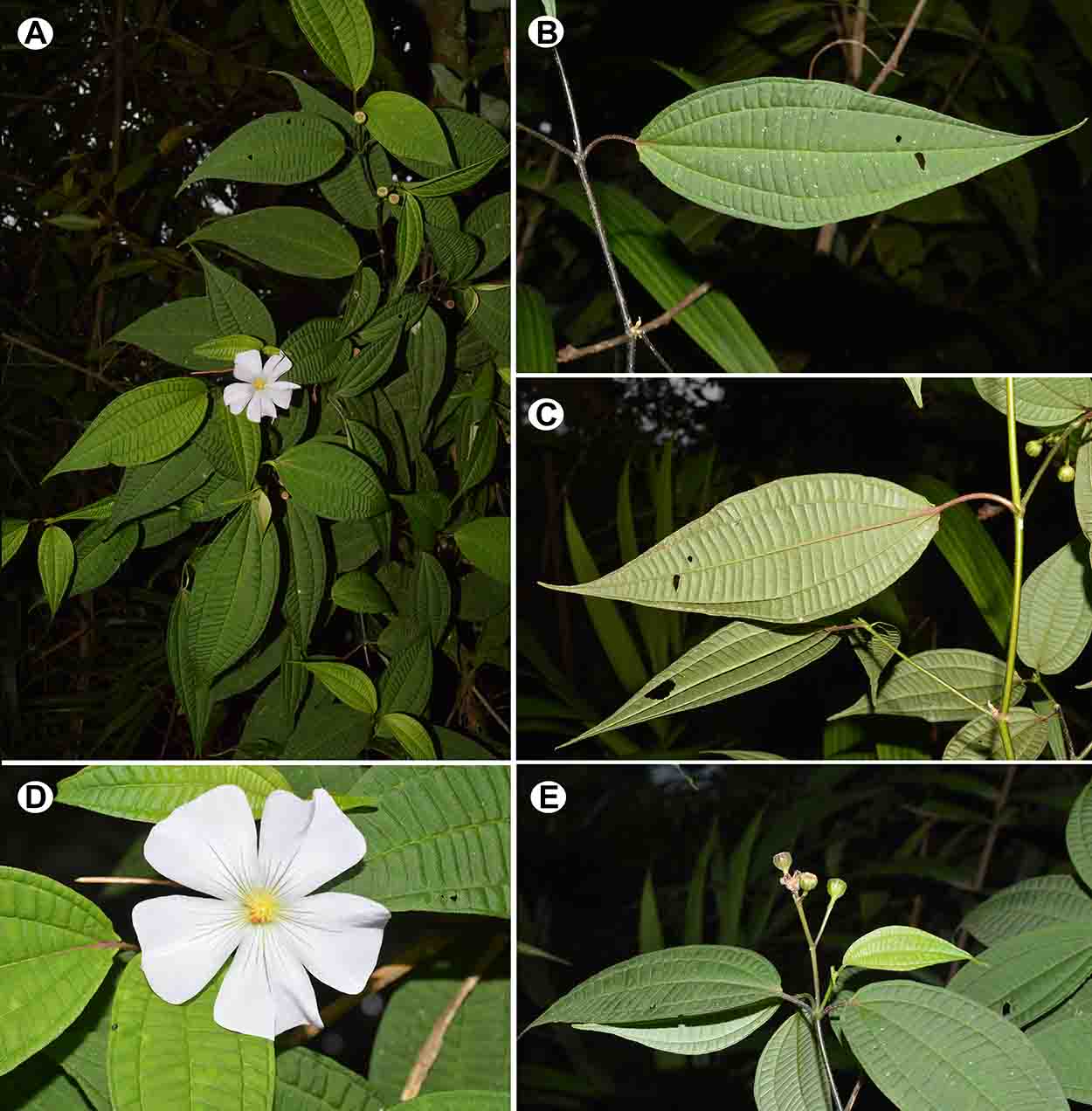
Background and Aims: Allomaieta (Melastomataceae, Cyphostyleae) is a genus of small trees and shrubs endemic to Colombia. Field explorations conducted between 2022 and 2025 in the eastern region of the department Caldas revealed specimens with unique basal revolute leaf margins. The aim of this study is to describe and illustrate Allomaieta basirevoluta sp. nov. from the Central Cordillera of the Colombian Andes, and discuss its taxonomic affinities, ecology, phenology, and conservation status.
Methods: Field collections were carried out near the Selva de Florencia National Natural Park. Herbarium collections and relevant taxonomic literature were reviewed. Morphological structures were measured from dried and ethanol-preserved specimens. Its conservation status was evaluated following IUCN Red List criteria.
Key results: Allomaieta basirevoluta is described as a new species known from the departments Caldas and Antioquia at elevations between 500 and 1000 m. It represents the first species within the tribe Cyphostyleae known to possess margin domatia. It is morphologically similar to A. javierbarrigae, from which it differs in its margin domatia and white petals, and to the white-flowered A. zenufanasana and A. ebejicosana, from which it differs in its sparsely strigose indumentum, simple dichasia with 3-5 flowers, and larger petals. Known from only two localities outside protected areas, the species is provisionally assessed as Endangered (EN) criterion B1ab(ii,iii,v)+2ab(ii,iii,v).
Conclusions: Allomaieta basirevoluta expands the known diversity of the genus to 14 species. The discovery of A. basirevoluta in unprotected forest remnants near Selva de Florencia National Natural Park highlights the conservation value of the lowland humid forests of the Magdalena valley in Caldas, where expanding livestock farming threatens the endemic flora.
Downloads
References
Almeda, F., H. Mendoza-Cifuentes, D. S. Penneys, F. A. Michelangeli and M. Alvear. 2016. Melastomataceae. In: Bernal, R., S. R. Gradstein and M. Celis (eds.). Catálogo de plantas y líquenes de Colombia, Vol. 2. Instituto de Ciencias Naturales, Universidad Nacional de Colombia. Bogotá, Colombia. Pp. 1588-1654. http://catalogoplantasdecolombia.unal.edu.co (consulted October, 2026).
Dauby, G., T. Stévart, V. Droissart, A. Cosiaux, V. Deblauwe, M. Simo-Droissart, M. S. M. Sosef, P. P. Lowry II, G. E. Schatz, R. E. Gereau and T. L. P. Couvreur. 2017. ConR: An R package to assist large-scale multispecies preliminary conservation assessments using distribution data. Ecology and Evolution 7(24): 11292-11303. DOI: https://doi.org/10.1002/ece3.3704 DOI: https://doi.org/10.1002/ece3.3704
ESRI. 2020. ArcGIS Pro v. 2.5. Environmental Systems Research Institute. Redlands, USA. https://www.esri.com/en-us/arcgis/products/arcgis-pro/overview (consulted October, 2026).
Gleason, H. A. 1929. Studies on the flora of northern South America-XII. Cyphostyleae: a new tribe of Melastomataceae. Bulletin of the Torrey Botanical Club 56(2): 97-112. DOI: https://doi.org/10.2307/2480434 DOI: https://doi.org/10.2307/2480434
Gleason, H. A. 1933. Studies on the flora of northern South America-XVIII. Plantae Lawranceanae Colombianae. Phytologia 1(1): 25-38. DOI: https://doi.org/10.5962/bhl.part.18987 DOI: https://doi.org/10.5962/bhl.part.18987
Gutiérrez-Duque, D. and J. M. Posada-Herrera. 2025. A new species of Miconia (Melastomataceae) with domatia from the Andean Cordilleras of Colombia. Brittonia 77(2): 184-193. DOI: https://doi.org/10.1007/s12228-025-09829-y DOI: https://doi.org/10.1007/s12228-025-09829-y
ICN. 2026. Colecciones en Línea. Instituto de Ciencias Naturales, Universidad Nacional de Colombia. https://www.biovirtual.unal.edu.co/ (consulted March, 2026).
IUCN. 2012. IUCN Red List Categories and Criteria: Version 3.1. Second edition. IUCN. Gland, Switzerland and Cambridge, UK. 32 pp. https://portals.iucn.org/library/node/10315 (consulted July, 2025).
IUCN. 2024. Guidelines for Using the IUCN Red List Categories and Criteria. Version 16. Prepared by the Standards and Petitions Committee. https://www.iucnredlist.org/documents/RedListGuidelines.pdf (consulted July, 2025).
JSTOR. 2026. Global Plants. https://plants.jstor.org/ (consulted March, 2026).
Judd, W. S., L. C. Majure, F. A. Michelangeli, R. Goldenberg, F. Almeda, D. S. Penneys and R. D. Stone. 2022. Morphological variability within the Melastomataceae (Myrtales), including a discussion of the associated terminology. In: Goldenberg, R., F. A. Michelangeli and F. Almeda (eds.). Systematics, Evolution, and Ecology of Melastomataceae. Springer. Cham, Switzerland. Pp. 46-85. DOI: https://doi.org/10.1007/978-3-030-99742-7_3 DOI: https://doi.org/10.1007/978-3-030-99742-7_3
Lozano, G. and N. Becerra-de-Lozano. 1999. Los géneros Allomaieta y Cyphostyla (Melastomataceae). Revista de la Academia Colombiana de Ciencias Exactas, Físicas y Naturales 23(86): 5-18. DOI: https://doi.org/10.18257/raccefyn.23(86).1999.2911
Mendoza-Cifuentes, H. 2018. Una nueva especie de Allomaieta (Melastomataceae: Cyphostyleae) del piedemonte amazónico de los Andes de Colombia. Biota Colombiana 19(Supl. 1): 10-16. DOI: https://doi.org/10.21068/c2018.v19s1a02 DOI: https://doi.org/10.21068/c2018.v19s1a02
Mendoza-Cifuentes, H. 2020. Revisión taxonómica del género Wurdastom (Melastomataceae: Cyphostyleae). Acta Botanica Mexicana 127: e1642. DOI: https://doi.org/10.21829/abm127.2020.1642 DOI: https://doi.org/10.21829/abm127.2020.1642
Michelangeli, F. A., A. Nicolas, M. E. Morales-P. and H. David. 2011. Phylogenetic relationships of Allomaieta, Alloneuron, Cyphostyla, and Wurdastom (Melastomataceae) and the resurrection of the tribe Cyphostyleae. International Journal of Plant Sciences 172(9): 1165-1178. DOI: https://doi.org/10.1086/662032 DOI: https://doi.org/10.1086/662032
Michelangeli, F. A., C. Ulloa Ulloa and K. Sosa. 2014. Quipuanthus, a new genus of Melastomataceae from the foothills of the Andes in Ecuador and Peru. Systematic Botany 39(2): 533-540. DOI: https://doi.org/10.1600/036364414X680924 DOI: https://doi.org/10.1600/036364414X680924
Michelangeli, F. A., J. S. Murillo-Serna and H. Mendoza-Cifuentes. 2022. The Cyphostyleae, a small tribe rich in rare characters in the family. In: Goldenberg, R., F. A. Michelangeli and F. Almeda (eds.). Systematics, Evolution, and Ecology of Melastomataceae. Springer. Cham, Switzerland. Pp. 307-319. DOI: https://doi.org/10.1007/978-3-030-99742-7_14 DOI: https://doi.org/10.1007/978-3-030-99742-7_14
Murillo-Serna, J. S. and H. David-Higuita. 2021. Una nueva especie de Allomaieta (Melastomataceae: Cyphostyleae) de Colombia. Brittonia 73(2): 189-194. DOI: https://doi.org/10.1007/s12228-021-09659-8 DOI: https://doi.org/10.1007/s12228-021-09659-8
Murillo-Serna, J. S., E. Trujillo-Trujillo, H. A. David-Higuita, O. Perdomo and H. Mendoza-Cifuentes. 2025a. Allomaieta isauroi (Melastomataceae, Cyphostyleae): a new species from the Andean-Amazonian Foothills of Colombia. Phytotaxa 711(1): 81-88. DOI: https://doi.org/10.11646/phytotaxa.711.1.6 DOI: https://doi.org/10.11646/phytotaxa.711.1.6
Murillo-Serna, J. S., J. A. Sierra-Giraldo, J. A. Orozco-A and J. M. Posada-Herrera. 2025b. Two new species of the Colombian endemic genus Allomaieta (Melastomataceae: Cyphostyleae). Phytotaxa 730(2): 177-188. DOI: https://doi.org/10.11646/phytotaxa.730.2.5 DOI: https://doi.org/10.11646/phytotaxa.730.2.5
R Core Team. 2025. R: A language and environment for statistical computing. R Foundation for Statistical Computing. Vienna, Austria. http://www.R-project.org/ (consulted July, 2025).
Romero, G. Q. and W. W. Benson. 2005. Biotic interactions of mites, plants and leaf domatia. Current Opinion in Plant Biology 8(4): 436-440. DOI: https://doi.org/10.1016/j.pbi.2005.05.006 DOI: https://doi.org/10.1016/j.pbi.2005.05.006
Thiers, B. 2026. Index Herbariorum: A global directory of public herbaria and associated staff. New York Botanical Garden’s Virtual Herbarium. http://sweetgum.nybg.org/science/ih/ (consulted July, 2026).
Wilkinson, H. P. 1979. The plant surface (mainly the leaf). In: Metcalfe, C. R. and L. Chalk (eds.). Anatomy of the Dicotyledons, Vol. 1., 2nd ed. Clarendon Press. Oxford, UK. Pp. 97-165.
Wurdack, J. J. 1986. Atlas of hairs for neotropical Melastomataceae. Smithsonian Contributions to Botany 63: 1-80. DOI: https://doi.org/10.5479/si.0081024X.63 DOI: https://doi.org/10.5479/si.0081024X.63
Downloads


Published
How to Cite
-
Abstract157
-
EPUB21
-
PDF135
Issue
Section
License

This work is licensed under a Creative Commons Attribution-NonCommercial 4.0 International License.
Authors who publish in this journal accept the following conditions:
In accordance with copyright legislation, Acta Botanica Mexicana recognizes and respects the moral rights of authors, as well as the ownership of the patrimonial right, which will be assigned to the journal for its dissemination in open access. Acta Botanica Mexicana does not charge authors for sending and processing articles for publication.
All the texts published by Acta Botanica Mexicana - without exception- are distributed under the Creative Commons 4.0 Attribution-Non Commercial License (CC BY-NC 4.0 International), which allows third parties to use what is published whenever they mention the authorship of the work and the first publication in this journal.
The authors can make other independent and additional contractual agreements for the non-exclusive distribution of the version of the article published in Acta Botanica Mexicana (for example, include it in an institutional repository or publish it in a book) as long as they clearly indicate that the work was published for the first time in Acta Botanica Mexicana
As a consequence, the copyeditors will request you, together with the galley review, to issue your Letter-Transfer of Ownership of Copyright form of the first publication duly completed and signed by the author(s). This letter should be sent by email in pdf file to the email: acta.botanica@inecol.mx (Letter-Transfer of Ownership of Copyright).


