
Gonolobus cthulhui (Apocynaceae), a new species from Oaxaca, Mexico
DOI:
https://doi.org/10.21829/abm129.2022.2067Keywords:
endemic species, Gonolobus leianthus, Gonolobus pancololote, Lovecraft.Abstract
Background and Aims: In Mexico, the genus Gonolobus is currently represented by 43 species. Gonolobus has been studied for some regional floras and taxonomic novelties are continuously being described. In this context, during the review of the herbarium material and collections made in the state of Oaxaca, a specimen that failed to be assigned to any described Gonolobus in Mexico and Mesoamerica was found. Therefore, the objective of this work was to describe a new species of Gonolobus from Oaxaca.
Methods: Eleven herbaria and five virtual collections were revised, and several field trips to Oaxaca were conducted in 2018 to collect specimens. The studied material was compared with other species with similar morphology, a comparative table was prepared, and a distribution map included. The conservation status of the species based on field observations according to the IUCN Red List criteria is presented.
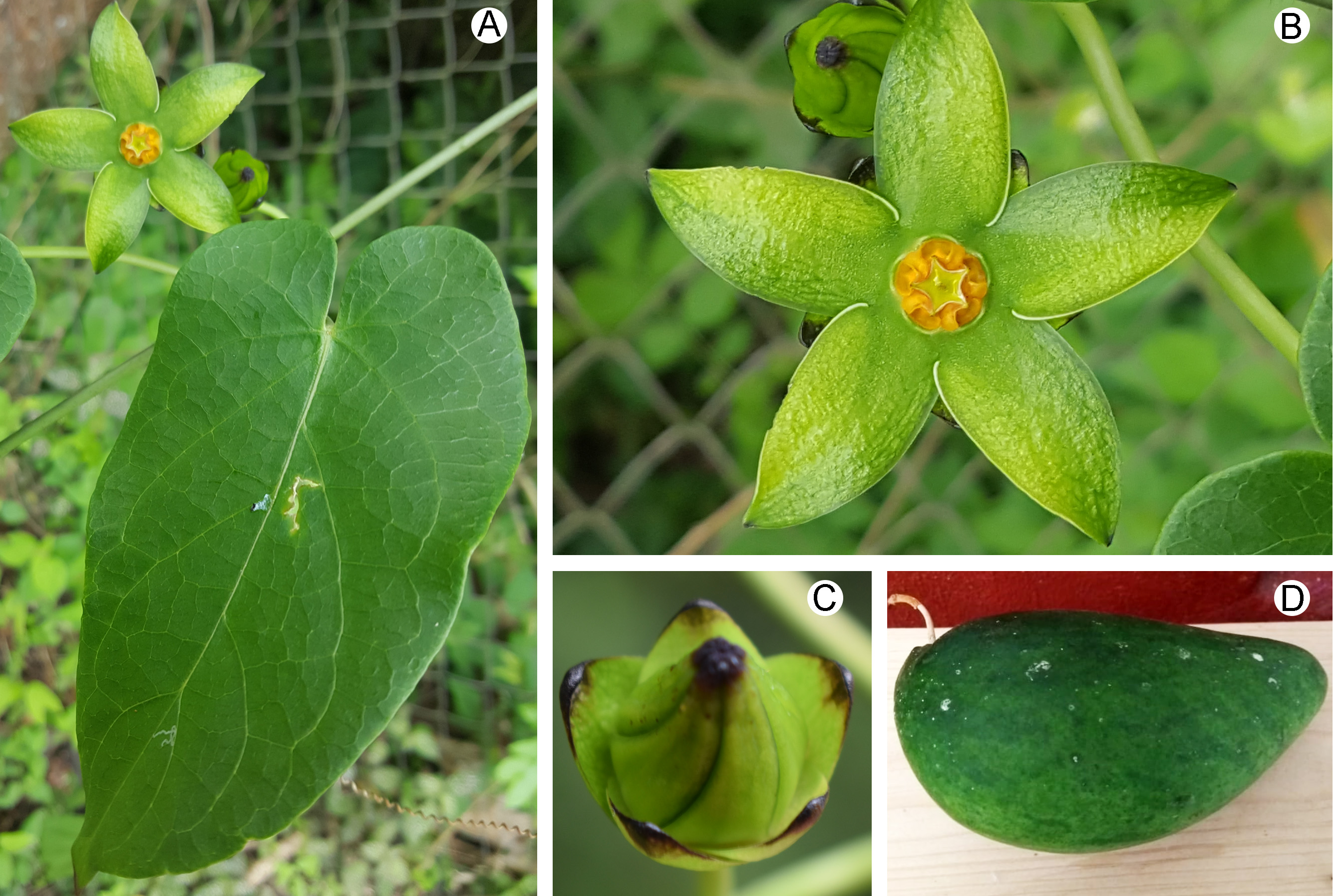
Key results: A new species of Gonolobus from southeastern Oaxaca, Mexico, with large green corollas, is described herein. A description and images of the new species are provided. Gonolobus cthulhui is morphologically similar to G. leianthus and G. pancololote, but differs by its black-tipped and widely ovate to suborbicular sepals, pubescent diagonal pattern on the corolla lobes, and thinner and discontinuous faucal annulus. An Endangered (EN) conservation category is suggested for this species.
Conclusions: This discovery highlights Oaxaca as the second state, after Chiapas, with most species of Gonolobus (19 spp.), and Mexico as a center of diversity for the genus, with 44 species recorded, of which 52.2% are endemic to the country.
Downloads
References
Alvarado-Cárdenas, L. O., L. Lozada-Pérez, C. S. Islas-Hernández, E. B. Cortez-Castro, K. G. Maya-Mandujano and M. G. Chávez-Hernández. 2020a. Apocináceas de ayer y hoy. Conocimiento histórico y reevaluación de la diversidad de Apocynaceae en México. Botanical Sciences 98(2): 393-416. DOI: https://doi.org/10.17129/botsci.2525 DOI: https://doi.org/10.17129/botsci.2525
Alvarado-Cárdenas, L. O., M. G. Chávez-Hernández and J. F. Pio-León. 2020b. Gonolobus naturalistae (Apocynaceae; Asclepiadoideae; Gonolobeae; Gonolobinae), a new species from Mexico. Phytotaxa 472(3): 249-258. DOI: https://doi.org/10.11646/phytotaxa.472.3.3 DOI: https://doi.org/10.11646/phytotaxa.472.3.3
Alvarado-Cárdenas, L. O., E. B. Cortez-Castro and C. Cervantes-Meza. 2021a. Gonolobus lozadae, una nueva especie de Apocynaceae del estado de Oaxaca, México. Botanical Sciences 99(2): 447-454. DOI: https://doi.org/10.17129/botsci.2783 DOI: https://doi.org/10.17129/botsci.2783
Alvarado-Cárdenas, L. O., M. G. Chávez-Hernández and C. G. Velazco-Macías. 2021b. Ajustes taxonómicos en Apocynaceae Mexicanas. Phytoneuron 2021(47): 1-22.
Alvarado-Cárdenas, L. O. and V. Juárez-Jaimes. 2012. Una especie nueva de Tabernaemontana (Apocynaceae: Rauvolfioideae) de México, seriamente amenazada en su hábitat. Revista Mexicana de Biodiversidad 83(2): 334-340. DOI: https://doi.org/10.22201/ib.20078706e.2012.2.978
Bachman, S., J. Moat, A. Hill, J. de la Torre and B. Scott. 2011. Supporting Red List threat assessments with GeoCAT: Geospatial Conservation Assessment Tool. ZooKeys 150: 117-126. DOI: https://doi.org/10.3897/zookeys.150.2109 DOI: https://doi.org/10.3897/zookeys.150.2109
BFG. 2020. Apocynaceae in Flora e Funga do Brasil. Brazilian Flora (BFG). Rio de Janeiro, Brazil. https://floradobrasil.jbrj.gov.br/FB4608 (consulted June, 2022).
Cortez, E. B. 2018. La familia Apocynaceae en el estado de Hidalgo, México. Tesis de licenciatura. Universidad Nacional Autónoma de México. Cd. Mx., México. 179 pp. https://repositorio.unam.mx/contenidos/203993 (consulted June, 2022)
Endress, M. E., U. Meve, D. J. Middleton and S. Liede-Schumann. 2018. Apocynaceae. In: Kadereit, J. W. and V. Bittrich (eds.). Flowering Plants. Eudicots, The Families and Genera of Vascular Plants 15. Springer International Publishing AG. Cham, Switzerland. Pp. 207-411. DOI: https://doi.org/10.1007/978-3-319-93605-5_3 DOI: https://doi.org/10.1007/978-3-319-93605-5_3
García, A. 2006. Using ecological niche modelling to identify diversity hotspots for the herpetofauna of Pacific lowlands and adjacent interior valleys of Mexico. Biological Conservation 130(1): 25-46. DOI: https://doi.org/10.1016/j.biocon.2005.11.030 DOI: https://doi.org/10.1016/j.biocon.2005.11.030
Google Earth. 2022. Google Earth. https://earth.google.com/web/ (consulted June, 2022).
Harris, J. G. and M. W. Harris. 1994. Plant identification terminology: an illustrated glossary. Spring Lake Publishing. Utah, USA. 216 pp.
Hickey, L. J. 1973. Classification of the architecture of dicotyledonous leaves. American Journal of Botany 60(1): 17-33. DOI: https://doi.org/10.2307/2441319 DOI: https://doi.org/10.1002/j.1537-2197.1973.tb10192.x
IUCN. 2019. The International Union for Conservation of Nature. Guidelines for using the International Union for Conservation of Nature Red List categories and criteria, Ver. 14. Prepared by the Standards and Petitions Subcommittee. https://www.iucnredlist.org/resources/redlistguidelines (consulted June, 2022).
JSTOR. 2021. JSTOR Global Plants. https://plants.jstor.org/ (consulted January, 2021).
Juárez-Jaimes, V. and L. Lozada-Pérez. 2003. Asclepiadaceae. Flora del Valle de Tehuacán-Cuicatlán 37: 1-57.
Juárez-Jaimes, V., W. D. Stevens and L. Lozada-Pérez. 2009. Gonolobus spiranthus (Apocynaceae, Asclepiadoideae), una nueva especie de la vertiente del Pacífico Mexicano. Novon 19(4): 479-481. DOI: https://doi.org/10.3417/2008023 DOI: https://doi.org/10.3417/2008023
K. 2021. Royal Botanic Gardens, Kew. http://apps.kew.org/herbcat/navigator.do (consulted January, 2021).
Krings, A. 2007. Novelties in Gonolobus (Apocynaceae: Asclepiadoideae) from the Lesser Antilles. Systematic Botany 32(1): 180-194. DOI: https://doi.org/10.1600/036364407780360247 DOI: https://doi.org/10.1600/036364407780360247
Krings, A. 2008. Revision of Gonolobus s.s. (Apocynaceae, Asclepiadoideae) in the West Indies. Journal of the Botanical Research Institute of Texas 2: 95-138.
Krings, A., D. T. Thomas and Q. Y. Xiang. 2008. On the generic circumscription of Gonolobus (Apocynaceae, Asclepiadoideae): evidence from molecules and morphology. Systematic Botany 33(2): 403-415. DOI: https://doi.org/10.1600/036364408784571527 DOI: https://doi.org/10.1600/036364408784571527
Krings, A. and Q. Y. Xiang. 2004. The Gonolobus complex (Apocynaceae: Asclepiadoideae) in the southeastern United States. Sida 21(1): 103-116.
Kunze, H. 1995. Floral morphology of some Gonolobeae (Asclepiadaceae). Botanische Jahrbücher für Systematik 117: 211-238.
Liede, S. and H. Kunze. 1993. A descriptive system for corona analysis in Asclepiadaceae and Periplocaceae. Plant Systematics and Evolution 185: 275-284. DOI: https://doi.org/10.1007/BF00937663 DOI: https://doi.org/10.1007/BF00937663
Mapes, C. and F. Basurto. 2016. Biodiversity and edible plants of Mexico. In: Lira, R., A. Casas and J. Blancas (eds.). Ethnobotany of Mexico: Interactions of people and plants in Mesoamerica. Springer. New York, USA. Pp. 99-100. DOI: https://doi.org/10.1007/978-1-4614-6669-7_5
Martínez-Domínguez, L., F. Nicolalde-Morejón, F. G. Lorea-Hernández, F. Vergara-Silva and D. W. Stevenson. 2020. A novelty in Ceratozamia (Zamiaceae, Cycadales) from the Sierra Madre del Sur, Mexico: biogeographic and morphological patterns, DNA barcoding and phenology. PhytoKeys 156: 1-25. DOI: https://doi.org/10.3897/phytokeys.156.53502 DOI: https://doi.org/10.3897/phytokeys.156.53502
McDonnell, A., M. Parks and M. Fishbein. 2018. Multilocus Phylogenetics of New World Milkweed Vines (Apocynaceae, Asclepiadoideae, Gonolobinae). Systematic Botany 43(1): 77-96. DOI: https://doi.org/10.1600/036364418X697021 DOI: https://doi.org/10.1600/036364418X697021
Morillo, G. 2015. Aportes al conocimiento de las Gonolobinae. Pittieria 39: 191-258.
Naturalista. 2022a. Género Gonolobus, observación 19939678. Naturalista, Comisión Nacional para el Conocimiento y Uso de la Biodiversidad. Cd. Mx., México. https://www.naturalista.mx/observations/19939678 (consulted January, 2021).
Naturalista. 2022b. Género Gonolobus, observación 1797700. Naturalista, Comisión Nacional para el Conocimiento y Uso de la Biodiversidad. Cd. Mx., México. https://www.naturalista.mx/observations/1797700 (consulted January, 2021).
Naturalista. 2022c. Género Gonolobus, observación 61743441. Naturalista, Comisión Nacional para el Conocimiento y Uso de la Biodiversidad. Cd. Mx., México. https://www.naturalista.mx/observations/61743441 (consulted January, 2021).
Naturalista. 2022d. Género Gonolobus, observación 27340862. Naturalista, Comisión Nacional para el Conocimiento y Uso de la Biodiversidad. Cd. Mx., México. https://www.naturalista.mx/observations/27340862 (consulted January, 2021).
Naturalista. 2022e. Género Gonolobus, observación 29344234. Naturalista, Comisión Nacional para el Conocimiento y Uso de la Biodiversidad. Cd. Mx., México. https://www.naturalista.mx/observations/29344234 (consulted January, 2021).
Naturalista. 2022f. Género Gonolobus, observación 35867653. Naturalista, Comisión Nacional para el Conocimiento y Uso de la Biodiversidad. Cd. Mx., México. https://www.naturalista.mx/observations/35867653 (consulted January, 2021).
NY. 2021. New York Botanical Garden, C. V. Starr Virtual Herbarium. http://sweetgum.nybg.org/science/vh/ (consulted January, 2021).
Peterson, A. T., J. Soberón and V. Sánchez-Cordero. 1999. Conservativism of ecological niches in evolutionary time. Science 285: 1265-1267. DOI: https://doi.org/10.1126/science.285.5431.1265 DOI: https://doi.org/10.1126/science.285.5431.1265
QGIS. 2020. QGIS ver. 3.26. Geographic Information System. Open Source Geospatial Foundation Project. http://qgis.osgeo.org (consulted January, 2021).
Rosatti, T. J. 1989. The genera of suborder Apocynineae (Apocynaceae and Asclepiadaceae) in the southeastern United States. Journal of the Arnold Arboretum 70(4): 307-401. DOI: https://doi.org/10.5962/bhl.part.19792 DOI: https://doi.org/10.5962/bhl.part.19789
Stevens, W. D. 2001a. Asclepiadaceae. In: Calderón de Rzedowski, G. and J. Rzedowski (eds.). Flora Fanerogámica del Valle de México. Instituto de Ecología, A.C., Comisión Nacional para el Conocimiento y Uso de la Biodiversidad. México, D.F., México. Pp. 564-576.
Stevens, W. D. 2001b. Asclepiadaceae. In: Stevens, W. D., C. Ulloa, A. Pool and O.M. Montiel (eds.). Flora de Nicaragua. Monographs in Systematic Botany Vol. 85, St. Louis Missouri Botanical Garden. Missouri, USA. Pp. 234-270.
Stevens, W. D. 2005. Fourteen new species of Gonolobus (Apocynaceae, Asclepiadoideae) from Mexico and Central America. Novon 15(1): 222-244.
Stevens, W. D. 2009. Apocynaceae. In: Davidse, G., M. Sousa, S. Knapp and F. Chiang (eds.). Flora Mesoamericana, Vol. 4, parte 1. Universidad Nacional Autónoma de México, Missouri Botanical Garden, The Natural History Museum (London). Cd. Mx., México. Pp. 733-741.
Stevens, W. D. and O. M. Montiel. 2004. Gonolobus incerianus (Apocynaceae, Asclepiadoideae), Una nueva especie de Mesoamérica. Novon 14(3): 350-353.
Templeton, A. R. 1989. The meaning of species and speciation: a genetic perspective. The units of evolution: Essays on the nature of species. 1992: 159-183. In: Otte, D. and J. Endler (eds.). Speciation and its Consequences. Massachusetts, USA. Pp. 3-27.
Thiers, B. 2021. Index Herbariorum: a global directory of public herbaria and associated staff. New York Botanical Garden’s Virtual Herbarium. http://sweetgum.nybg.org/ih. (consulted June, 2021).
TROPICOS. 2021. Tropicos.org. Missouri Botanical Garden. https://www.tropicos.org/home (consulted January, 2021).
UC. 2021. The University and Jepson Herbaria, University of California, Berkeley. https://ucjeps.berkeley.edu/ (consulted June, 2021).
Zilli, A., J. D. Holloway and W. Hogenes. 2005. An overview of the genus Speiredonia with description of seven new species (Insecta, Lepidoptera: Noctuidae). Aldrovandia 1: 17-36.
Downloads


Published
How to Cite
-
Abstract4867
-
PDF1122
-
XML (Español)111
-
EPUB264
Issue
Section
License

This work is licensed under a Creative Commons Attribution-NonCommercial 4.0 International License.
Authors who publish in this journal accept the following conditions:
In accordance with copyright legislation, Acta Botanica Mexicana recognizes and respects the moral rights of authors, as well as the ownership of the patrimonial right, which will be assigned to the journal for its dissemination in open access. Acta Botanica Mexicana does not charge authors for sending and processing articles for publication.
All the texts published by Acta Botanica Mexicana - without exception- are distributed under the Creative Commons 4.0 Attribution-Non Commercial License (CC BY-NC 4.0 International), which allows third parties to use what is published whenever they mention the authorship of the work and the first publication in this journal.
The authors can make other independent and additional contractual agreements for the non-exclusive distribution of the version of the article published in Acta Botanica Mexicana (for example, include it in an institutional repository or publish it in a book) as long as they clearly indicate that the work was published for the first time in Acta Botanica Mexicana
As a consequence, the copyeditors will request you, together with the galley review, to issue your Letter-Transfer of Ownership of Copyright form of the first publication duly completed and signed by the author(s). This letter should be sent by email in pdf file to the email: acta.botanica@inecol.mx (Letter-Transfer of Ownership of Copyright).


